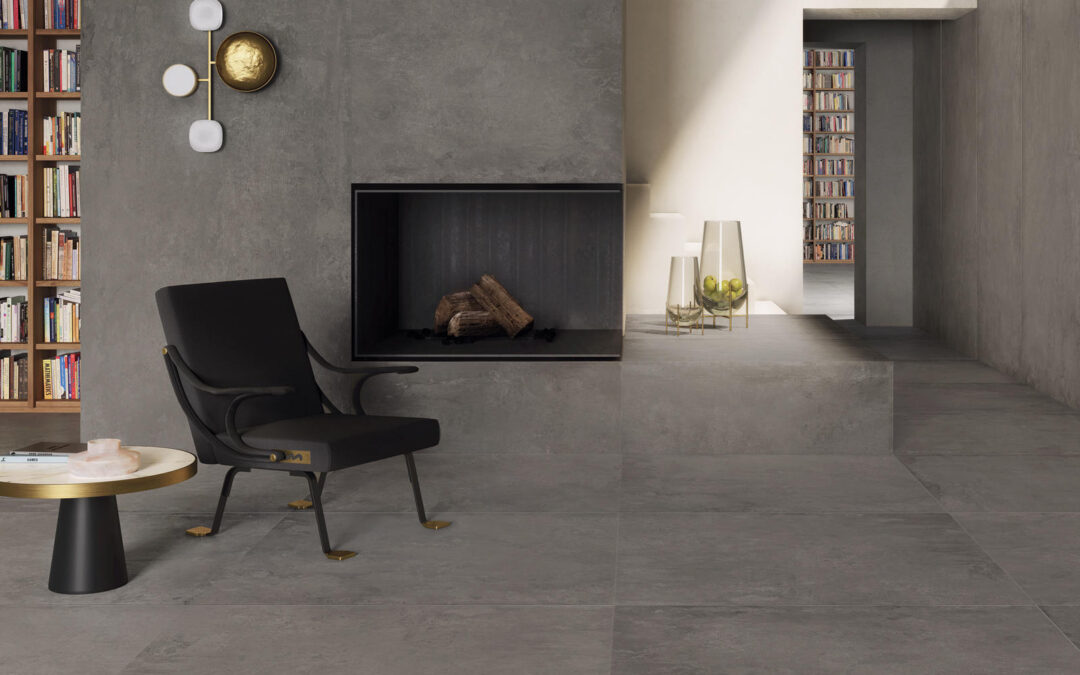
In the microcement vs porcelain debate for the bathroom there’s no single winner — just two routes to the same calm, seamless space. Microcement is a continuous coating applied by hand on site, in layers of 2-3 mm, giving a single-piece surface with no grout lines. Microcement-effect porcelain recreates that warm, mineral look on a waterproof body, with absorption ≤0.5% and minimal joints. We compare continuity, water resistance, durability, installation and long-term cost — with the unhurried eye of someone who lives with Mallorca’s light and climate.
In short
- Microcement-effect porcelain mimics the continuous, minimalist look of microcement, but without cracking or sealing.
- Real microcement is a seamless layer, but more delicate and higher-maintenance; porcelain is tougher and easier.
- For bathrooms and wet areas, microcement-effect porcelain is usually the more practical choice.
What sets microcement apart from microcement-effect porcelain?
Nature, not just appearance. Microcement is a cement-based mortar applied by hand in 2-3 mm layers over the existing surface, then sealed for water resistance. Microcement-effect porcelain is stoneware fired above 1,200°C that imitates the texture but arrives waterproof from the factory (≤0.5%). Microcement is a continuous surface built layer by layer; porcelain imitates it with large-format pieces and near-invisible joints.
Which looks more seamless?
For pure continuity, microcement wins: not a single joint. Porcelain isn’t far behind: with large formats — up to 120×120 cm, bigger in Inalco MDi — and a tone-matched minimal joint (1.5-2 mm), the eye reads an almost continuous surface, with a tough body behind it.
Which handles water and stains better?
Porcelain wins clearly. Absorption ≤0.5%: waterproof from the outset, no sealing, no porous foothold for mould. Microcement is porous by nature; its resistance depends on the sealer (varnish or resin), which wears and must be renewed every 3-5 years. An ageing seal shows up as stains from soaps, cosmetic oils or limescale.
And durability and hairline cracks over time?
Porcelain leads: hard, scratch-resistant, dimensionally stable, won’t crack over a well-prepared base. Microcement is tear-resistant but prone to hairline cracking if the base isn’t stable or the building moves. In old Mallorcan stone-house renovations, a risk to weigh with your applicator.
How does installation differ?
Two philosophies. Microcement is applied on site, by hand, in several coats with drying times; it can go over existing tile or floor with no demolition (ideal for fast renovations), but depends entirely on the applicator’s hand. Porcelain is installed as tile with adhesive by a ceramic tiler; the result is more predictable and uniform. Our porcelain flooring allows floor-to-wall continuity in the same model.
If your question is the shower, the decisions to make before work begins are in walk-in shower: which materials to choose.
What works out better in the long run?
Porcelain is usually cheaper to keep: no reseals, no protective coat to renew, no banned everyday cleaners; almost all the cost sits in installation. Microcement concentrates high specialist labour plus recurring upkeep (a reseal every 3-5 years). That’s why more projects choose microcement-effect porcelain — Sira Concrete, Inalco MDi or Coem — as the low-maintenance option.
| Criterion | Microcement | Microcement-effect porcelain |
|---|---|---|
| Seamless look / joints | Jointless, monolithic on-site | Minimal joints (1.5-2 mm), near-invisible tone-matched |
| Water resistance | Porous; depends on the sealer | Waterproof from factory, ≤0.5% |
| Stains | Vulnerable as the seal ages | Highly resistant; no sealing |
| Durability / cracks | Hairline-crack risk on unstable base | Very stable, scratch-resistant |
| Thickness | 2-3 mm | Tile thickness |
| Installation | On site, by hand, no demolition | Tile with adhesive |
| Maintenance | Reseal every 3-5 years | Ordinary cleaning; no reseals |
| Long-term cost | High (labour + upkeep) | Concentrated in installation; low after |
Conclusion
We’re not choosing better or worse, but what we value most. Microcement gives hand-crafted continuity in exchange for specialist labour and faithful upkeep. Microcement-effect porcelain offers that mineral calm with minimal joints, factory waterproofing (≤0.5%) and almost no maintenance. For most bathrooms in Mallorca, the balance tips towards porcelain. Discover the concrete-effect ranges in bathroom and spa.
Frequently asked questions
- Which is better, microcement or porcelain? Total continuity favours microcement; water resistance and low maintenance favour microcement-effect porcelain (≤0.5%, no sealing).
- Does it look the same as real microcement? Very close: large format and a tone-matched minimal joint recreate the mineral texture on a waterproof body.
- How often does microcement need maintenance? A reseal every 3-5 years plus mild cleaning.
- Does microcement crack? Hairline cracks can appear if the base isn’t stable or the structure moves.
- Does porcelain need sealing? No: ≤0.5%, waterproof from the outset, no aftercare.