Choosing between a porcelain, Dekton or quartz countertop is one of the decisions that most shapes a kitchen, and also one that causes the most confusion. At a glance the three materials look alike —smooth, continuous, contemporary surfaces— but inside they are very different: their composition, their reaction to heat, their behaviour under the sun and their daily upkeep all change. At Gomila we work with large-format sintered and porcelain surfaces, so in this guide we compare all three with honest technical criteria, to help you choose the countertop that truly fits how you cook and live in your home in Mallorca.
In short
- Porcelain countertops and Dekton (technical porcelain) handle heat and scratching better than quartz and need no sealing.
- Quartz (e.g. Silestone) is tough but sensitive to direct heat and to UV outdoors.
- Porcelain allows large format and worked edges (Smart Edges); Dekton is Cosentino’s technical porcelain brand.
What is each material? Composition and process
The difference begins at the factory, and understanding it clears up almost everything else. Sintered porcelain is made from natural minerals —clays, feldspars, quartz, oxides— that are pressed and fired at temperatures above 1,200 °C. That extreme heat fuses and compacts the particles into a dense, homogeneous, virtually non-porous mass. The key point: it contains no resins. It is pure technical stone. Under this umbrella sit the Inalco MDi and Ragno RealStone surfaces we distribute at Gomila. Dekton, by Cosentino, is also a sintered stone. It is worth being clear about this to avoid false oppositions: when we compare “porcelain vs Dekton”, we are really comparing two very close families within the sintered world. Dekton is produced through a particle-sintering process that combines a blend of more than 20 minerals under pressure and heat. The result is an ultra-compact surface that shares nearly all the virtues of technical porcelain. The main difference is not one of category, but of brand, finishes and some manufacturing nuance. Compact quartz (Silestone and similar) plays in a different technical league. It is an agglomerate: roughly 90–94 % ground quartz bound with about 6–10 % polyester resin and pigments. That resin gives cohesion, uniform colour and a warm feel… but it is also its weak point, as we will see. It is not stone fired at high temperature, but mineral bonded with polymer. In short: porcelain and Dekton are resin-free sintered cousins; quartz is a resin-bound compound. That single sentence explains 80 % of the differences in use.
Which handles kitchen heat best?
This is where composition shows most clearly, and where the paths truly diverge. Sintered porcelain resists heat exceptionally well. With no resins and having been fired above 1,200 °C, you can place a pot or pan straight off the flame directly onto the countertop with no fear of marks or warping. Dekton behaves just as well: Cosentino documents resistance to temperatures of up to around 300 °C and to accidental thermal shock. On heat, porcelain and Dekton tie at the top. Quartz, by contrast, fears heat because of its resin. The polyester begins to degrade from around 150 °C, so placing a hot pan directly on it can cause thermal shock and leave a yellowish, irreparable mark. It is not a manufacturing flaw: it is the nature of the material. With quartz, the trivet stops being optional and becomes mandatory. If you cook a lot, over a lively flame, and want to forget about heat care, sintered stone —porcelain or Dekton— wins clearly.
Scratching, staining and porosity: everyday life
In surface hardness the three materials all perform well, but with nuances. Porcelain and Dekton offer very high scratch resistance and practically zero porosity. With no pores, they barely absorb liquids: wine, oil, coffee or lemon wipe away without a trace and without periodic sealing. They are hygienic surfaces, ideal for anyone wanting minimal upkeep. Quartz also resists scratching well and is low in porosity thanks to the resin that seals the gaps between particles. Against everyday stains it holds up very well. Its limit, we insist, is thermal and —as we will see— solar, rather than daily scratching. In all three cases it is best to avoid cutting directly on the countertop: not necessarily for fear of scratching, but because your knife edge will thank you. The board is still your ally.
What if the kitchen faces the sun or is outdoors?
This point is decisive in Mallorca, where open kitchens, breakfast areas with large windows and garden barbecue zones are common. Porcelain and Dekton are UV-resistant. Their colour does not change under prolonged sun exposure, which makes them suitable for outdoors: terrace kitchens, islands beside south-facing windows or very bright breakfast areas. The colour you choose is the colour you will have ten years from now. Quartz, on the other hand, is not designed for outdoor use or for intense, continuous sun exposure. Its tones —especially whites— can yellow over time under UV radiation. That is why most quartz manufacturers advise against outdoor use. If your countertop will get direct sun for much of the day, sintered stone is the technically sensible choice.
Thicknesses, large format and edge
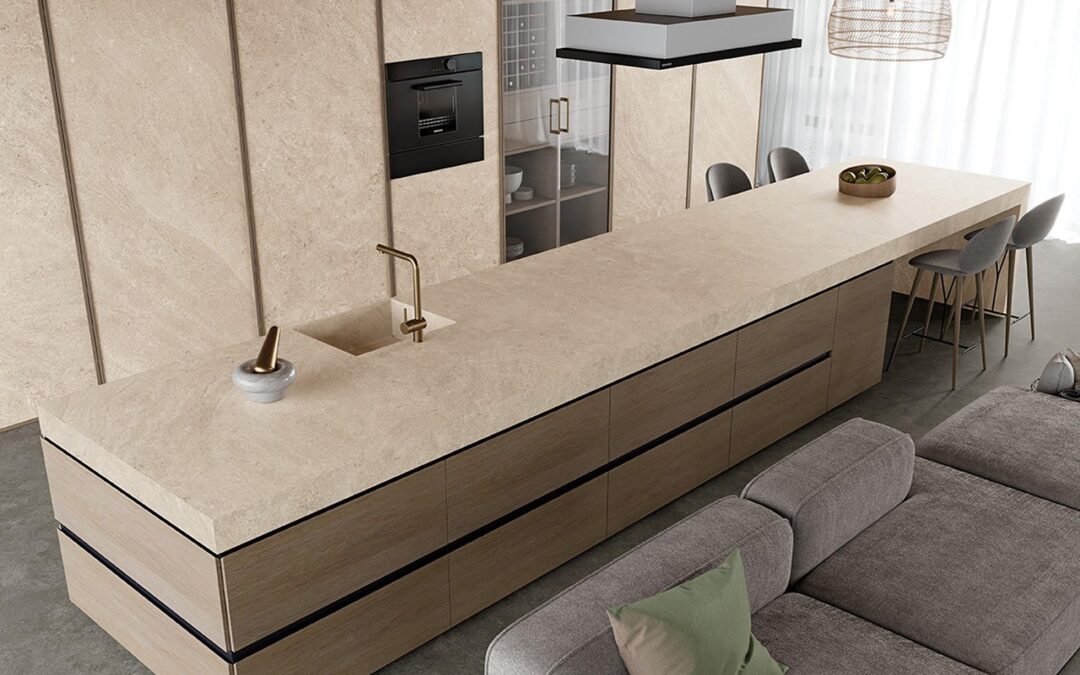
Beyond the material, a countertop’s aesthetic depends greatly on the thickness and format of the slab. Sintered stone is usually offered in 12 mm thickness —light, contemporary, perfect for slim lines— and 20 mm, with more presence and a sense of solidity. Moreover, both porcelain and Dekton are produced in large slabs (oversized formats), allowing continuous countertops with very few joints, or even none across generous runs. Fewer joints means a cleaner image and fewer spots where dirt accumulates. The edge allows several treatments: straight, mitred (joining two pieces at an angle to simulate greater thickness with no extra weight), bevelled or rounded. The mitre is especially popular in design kitchens because it achieves solid-looking countertops —4, 6 or more visual centimetres— while keeping the material’s real lightness. The large format of porcelain also opens the door to material continuity: the same surface on countertop, splashback and even flooring, for a very current wraparound effect.
Price: what does each option translate to?
Let’s talk price honestly and without invented figures, because the final cost depends on many variables: format, thickness, finish, edge type, linear metres and installation complexity. As a rough, qualitative guide: quartz usually sits in a more accessible entry band, which explains much of its popularity. Sintered porcelain and Dekton tend to position themselves a little higher, justified by their thermal and UV performance and by large-format technology. Between porcelain and Dekton, the price difference depends mostly on brand, specific finish and collection, rather than on the material category. Our advice: don’t look only at the price per metre, but at the total installed cost and —above all— the service life without surprises. A countertop that fears neither heat nor sun usually pays off better in the long run.
Comparison table: porcelain, Dekton and quartz
| Criterion | Sintered porcelain (Inalco MDi, RealStone) | Dekton | Quartz |
|---|---|---|---|
| Composition | Sintered natural minerals, no resins | Cosentino sintered stone, 20+ minerals, no resins | Agglomerate: ~90–94 % quartz + ~6–10 % polyester resin |
| Process | Fired >1,200 °C | Particle sintering | Resin compaction |
| Heat resistance | Very high | Very high (up to ~300 °C) | Limited: resin degrades from ~150 °C |
| Scratching | Very high | Very high | High |
| Staining / porosity | Near-zero porosity | Near-zero porosity | Low porosity (via resin) |
| UV resistance / outdoor | Yes, outdoor-suitable | Yes, outdoor-suitable | Not recommended: can yellow |
| Common thicknesses | 12 and 20 mm | 12 and 20 mm | Varies by maker |
| Large format | Yes | Yes | More limited |
| Guide price | Mid-to-upper band | Mid-to-upper band | More accessible entry band |
Conclusion
In the porcelain vs Dekton vs quartz comparison there is no absolute winner, but a choice based on priorities. If you want maximum peace of mind —direct heat without a trivet, sun exposure without yellowing and minimal upkeep— sintered material is the answer, and there porcelain and Dekton play at practically the same level, because both are sintered stone. Quartz remains a valid, more accessible option for indoor kitchens without intense sun and with careful thermal use. At Gomila we back large-format porcelain and sintered stone: Inalco MDi and Ragno RealStone surfaces that combine technical resistance, generous formats and a serene aesthetic, very much in keeping with the Mediterranean architecture of Mallorca. If you have a kitchen project in hand, we’ll help you choose the material, thickness and edge that best define it.
With the worktop decided, the rest of the kitchen: what to choose for each area.
Frequently asked questions
- Is a porcelain countertop the same as Dekton? They are very close families. Dekton is a Cosentino sintered stone, from the same technical world as sintered porcelain. Both are made by sintering, resin-free, and share nearly all their performance. The main difference is brand, finishes and some process nuance, not category.
- Can I rest a hot pan on the countertop? On sintered porcelain and Dekton, yes: they handle direct heat very well. On quartz it is not advisable, because its resin degrades from around 150 °C and can leave a yellowish, irreparable mark.
- Does quartz yellow in the sun? It can. Quartz tones, especially whites, tend to yellow with prolonged UV exposure, so it is not recommended outdoors or for very sunny kitchens. Porcelain and Dekton are UV-resistant.
- Which thickness should I choose, 12 or 20 mm? 12 mm gives a slim, contemporary line; 20 mm adds more presence and solidity. With a mitred edge you can achieve solid-looking countertops from light thicknesses, adding visual depth without extra weight.
- Which is more expensive, porcelain, Dekton or quartz? As a guide, quartz usually sits in a more accessible entry band, while porcelain and Dekton tend to a slightly higher band for their performance and large-format technology. The final cost depends on format, finish, edge and installation.