What R11 means is the question that surfaces the moment a project meets water: a level-access shower, the edge of a pool, the kitchen of a stone finca in Mallorca. R11 is a slip-resistance rating from the German DIN 51130 ramp test, and it tells you the surface keeps your footing secure up to an incline of between 19° and 27° while shod. This isn’t a catalogue flourish; it’s safety, and often a legal requirement. In this guide we untangle the three scales that coexist on a spec sheet — R9-R13, Spain’s Class 0-3, and the DCOF — so you can choose with real confidence.
In short
- R11 is a slip-resistance class under the German standard DIN 51130 (ramp test), within the R9-R13 scale.
- Higher number = more anti-slip: from R9 (low) to R13 (maximum). R11 is typical for outdoors, showers and pool areas.
- In Spain, the CTE code rates slipperiness in Class 0-3 and uses the DCOF value (≥0.42 is considered safe when wet).
- Quick guide by area: dry interiors R9-R10; bathrooms and kitchens R10-R11; outdoors and pools R11-R12.
- Slip class is not the same as hardness or wear resistance (PEI): they are different properties.
What does R11 actually mean?
R11 means a floor, tested on the DIN 51130 ramp with a shod operator and lubricating oil, holds firm up to an incline of 19°–27°. It’s the third of five ratings (R9 to R13) and the one most in demand for wet circulation areas and outdoors. The steeper the tolerated angle, the greater the resistance. R13 (>35°) tops the scale, reserved for commercial kitchens and ramps, where such a texture would feel rough underfoot in a home.
What does the R9-R13 ramp test scale measure?
The R scale measures the maximum incline a surface tolerates before a shod operator slips (DIN 51130) — the European system you see most on porcelain spec sheets.
| R rating | Incline angle | Friction coefficient | Typical use |
|---|---|---|---|
| R9 | 6°–10° | 0.11–0.18 | Dry interiors: living room, bedroom |
| R10 | >10°–19° | 0.19–0.34 | Domestic kitchens, bathrooms, entrances |
| R11 | >19°–27° | 0.35–0.51 | Terraces, showers, poolside, outdoors |
| R12 | >27°–35° | 0.52–0.70 | Wet work areas, ramps |
| R13 | >35° | >0.70 | Commercial kitchens, heavy use |
The R scale is tested shod; for barefoot zones there’s a sister scale, DIN 51097’s A-B-C system, where C is safest. A higher texture isn’t always better: the more aggressive, the harder to clean.
And Spain’s CTE Class 0-3? How does it differ from R11?
Class 0-3 is Spain’s official classification, measuring the slip value Rd (friction pendulum, UNE-ENV 12633). It isn’t the German ramp test, so R11 and Class 3 are not legally equivalent, even if they line up closely. CTE Basic Document SUA-1 groups floors into four classes:
| CTE Class | Rd value (pendulum) | Indicative ramp match |
|---|---|---|
| Class 0 | Rd ≤ 15 | R9 |
| Class 1 | 15 < Rd ≤ 35 | R9–R10 |
| Class 2 | 35 < Rd ≤ 45 | R10–R11 |
| Class 3 | Rd > 45 | R11–R13 |
That matching column is indicative, not regulatory: compliance is evidenced by the Rd value and the CTE class.
Stairs ask for one class more than the flat floor: we apply it in porcelain tiles for stairs.
Which class does the CTE require in each room?
| Location | Minimum class |
|---|---|
| Dry interiors (slope < 6%): living room, bedroom | Class 1 |
| Dry interiors with slope ≥ 6% and stairs | Class 2 |
| Wet interiors (bathrooms, kitchens, entrances, covered terraces), slope < 6% | Class 2 |
| Wet interiors with slope ≥ 6% and stairs | Class 3 |
| Outdoor areas, pools (depth ≤ 1.50 m) and showers | Class 3 |
In a Mallorcan home: living room Class 1, bathroom and kitchen Class 2, terrace, porch and poolside Class 3. Our outdoor porcelain flooring and pool series start from Class 3.
How Class 3 applies to a shower floor, and the barefoot scale, is explained in walk-in and level-access showers.
What is DCOF ≥ 0.42 and when does it matter?
DCOF (dynamic coefficient of friction) is measured by the American ANSI A137.1 method (BOT-3000 tribometer, wet). The threshold is 0.42 = suitable for interiors that may get wet. Dominant on US-referenced projects; in Spain it’s complementary to Class 0-3, an added guarantee of wet grip.
Polished, matte or structured? How the finish changes everything
- Polished (lappato/glossy): mirror-like, low Rd (≈R9/Class 1). Dry interiors only — never bathroom, wet kitchen or outdoors.
- Matte (natural): most versatile, R10/Class 2. Ideal for most of a home.
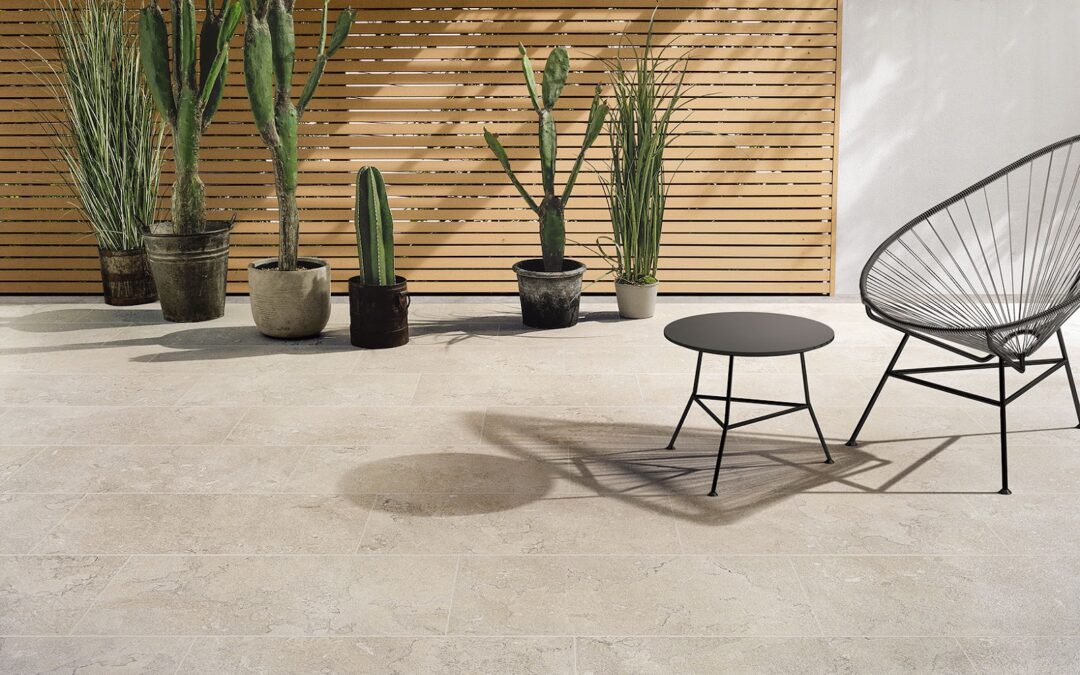
- Structured (grip, outdoor, 20 mm): pronounced relief, R11-R12/Class 3. Terraces, porches, pool copings.
In Mallorca the usual pairing is a continuous matte indoors carried on as a structured finish in the same tone outside. It’s the foundation of a good bathroom and spa project that flows out to the terrace.
| Ramp Test | CTE Class (Rd) | Rd range | Typical finish | Recommended location |
|---|---|---|---|---|
| R9 | Class 1 | 15–35 | Polished / natural | Living room, bedroom (dry) |
| R10 | Class 2 | 35–45 | Matte natural | Bathroom, kitchen, entrance |
| R11 | Class 3 | >45 | Structured | Terrace, shower, outdoors |
| R12 | Class 3 | >45 | Structured grip | Ramps, very wet areas |
An anti-slip surface is cleaned differently: we cover it in how to clean porcelain tiles.
Conclusion
Choosing the right slip resistance isn’t about reading a code — it’s about understanding three languages describing the same thing: the foot that doesn’t slide. The R scale gives you the angle, the CTE class sets the law, and the DCOF adds an international guarantee. At Gomila we approach every project from that dual demand, technical and sensory.
Frequently asked questions
- What does R11 mean on a floor tile? Slip resistance (DIN 51130): resists slipping up to 19°–27° while shod. Suitable for terraces, showers, outdoors and poolsides.
- Is R11 the same as CTE Class 3? Not exactly. R11 = German ramp; Class 3 = Spanish pendulum (Rd > 45). The match is indicative; in Spain compliance is evidenced by the CTE class.
- Which slip class does the CTE require for a bathroom? Class 2 minimum (wet interiors, slope < 6%); Class 3 if slope ≥ 6% or stairs.
- What DCOF does a wet area need? DCOF ≥ 0.42 (ANSI A137.1). In Spain it’s complementary to the CTE Class 0-3.
- Can I use polished porcelain on a terrace or bathroom? Not advisable and usually non-compliant: polished is ≈R9/Class 1, dry interiors only.
Related: Looking for a Class 3 slip-resistant porcelain for your pool? Discover Trésor Bali by Rosa Gres.
Once you know which slip rating you need, the best part remains: choosing the look. In our guide to stone effect porcelain tiles you’ll see collections — like Sinai by Coem with R11 Soft & Safe — that combine safety and natural beauty.
If what you have in front of you is a terrace, the full decision —thickness, slip rating and laying system— is in outdoor porcelain paving in Mallorca.