Choosing the right tiles for a small bathroom is the most direct way to gain a sense of space without moving a single wall. Tile can’t add square metres, but it changes how the eye reads them: a thinner grout line, a lighter tone or a surface that bounces the light can turn a cramped bathroom into something calm and easy to breathe in. At Gomila Cerámica, distributors in Mallorca of brands like WOW, Ragno and Inalco, we’ve gathered eight concrete, proven strategies so your tiles work in favour of Mediterranean light and a feeling of openness.
In short
- In a small bathroom, large formats and grout matching the tile colour make the space feel bigger.
- Light tones and floor-to-wall continuity add a sense of space; glossy finishes bounce light.
- Large-format porcelain reduces grout lines and is easier to clean.
Why does large-format tile make a small bathroom look bigger?
Large format looks bigger because it cuts down grout joints, and joints break up the eye’s path. With slabs like Inalco’s MDi (up to 160×320 cm, 4/6/10/12 mm) a single piece can clad an entire wall panel almost seamlessly. Laid rectified, it allows minimal 2 mm joints — the result feels monolithic. In 3-4 m² bathrooms, that’s the difference between a chopped-up room and one that breathes.
What tile colours make a narrow bathroom feel wider?
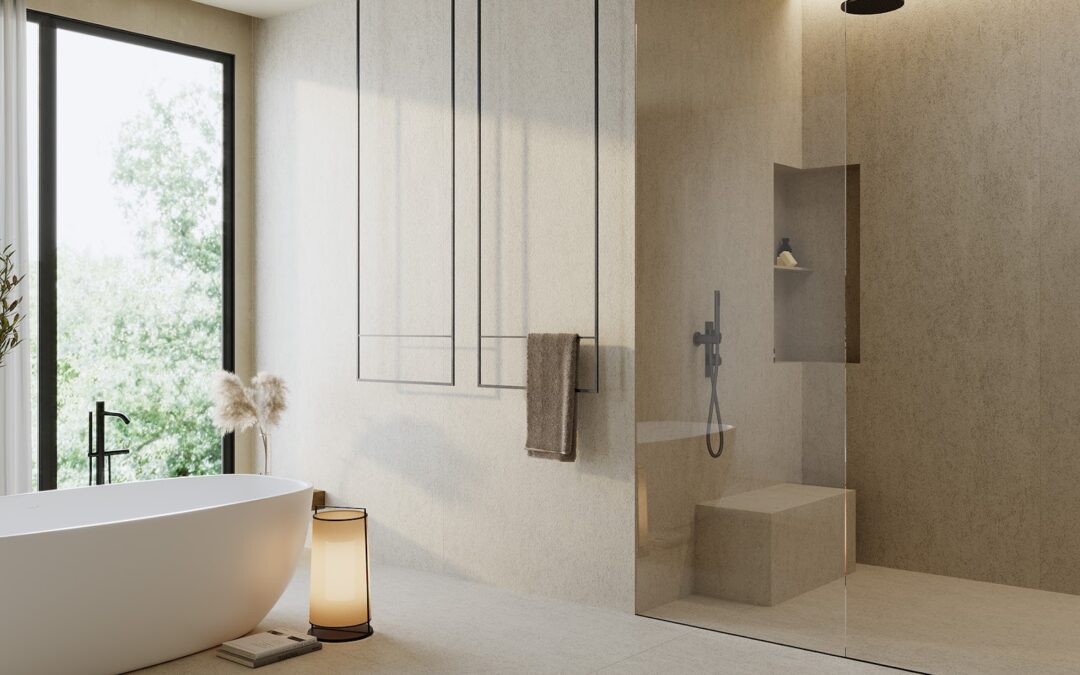
Light colours widen a room because they reflect light and soften the edges. Whites, sands, pearl greys and warm beiges make walls seem to recede. The most effective move is floor-to-wall continuity: the same tonal range — or the same tile — from floor up through the wall. Without a break at mid-height, the eye reads one generous volume. Mallorca’s light flatters light neutrals with a luminous finish.
Does a marble effect work in small bathrooms?
Yes: a luminous marble effect adds depth without clutter. Choose marbles with a light background and discreet veining. WOW’s Marble honours marble in 11×11 cm Matt; Inalco’s MDi offers luminous marbles in large format with veining that flows piece to piece. Both bring elegance without visual weight.
Gloss or matt in a bathroom with no natural light?
In a bathroom short on daylight, gloss wins: it reflects artificial light and spreads it. Ragno’s Glacé (7.5×20 cm, Rayé 3D) catches light on every piece; Lucida (30×90 cm) lays gloss over a wavy base for lively reflections. Reserve gloss for one panel — the shower wall, the vanity backsplash — to concentrate the effect where light is needed.
How do you use verticality to gain height?
Verticality stretches the bathroom upward: elongated tiles laid vertically, or wall covering carried to the ceiling, make the eye read more height. Rectangular formats — Ragno’s 40×120 cm, Lucida’s 30×90 — are ideal upright. Simple rule: tile floor to ceiling to remove the horizontal line that flattens the space.
Should you use the same tile inside and outside the shower?
Yes: it removes the visual border that shrinks the bathroom. The same rectified porcelain across floor, wall and base (2-3 mm joint) blends the shower in. Many collections offer a non-slip option — like the R11 in WOW’s Marble series — keeping the look with the safety a shower floor demands.
| Strategy | Visual effect | Recommended collection |
|---|---|---|
| Large format (fewer joints) | Continuous surface | Inalco MDi (up to 160×320 cm) |
| Light colours + floor-to-wall continuity | Edges blur, more light | Inalco MDi light / WOW Marble Sand |
| Luminous marble effect | Depth without clutter | WOW Marble · Inalco MDi marble |
| Rectified pieces (2-3 mm joint) | Monolithic look | Large-format rectified porcelain |
| Gloss finish | Multiplies artificial brightness | Ragno Glacé · Ragno Lucida |
| Verticality (tiles upright) | Sense of greater height | Ragno 40×120 · Lucida 30×90 |
| Same material in the shower | No border, unified space | Rectified porcelain + R11 |
| Continuous skirting | Seamless base, larger floor | Same tile floor-to-skirting |
How to handle that continuous floor (format, falls and slip resistance) is covered in walk-in shower: which materials to choose.
What does a continuous skirting in the same material add?
It removes the contrast line at the base of the wall and makes the floor appear to extend. With rectified porcelain, cut a strip from the floor tile and run it up the wall, perfectly aligned. With no contrast joint, the floor-to-wall transition disappears and the bathroom gains quiet continuity.
Conclusion
No small bathroom is doomed to feel small. The eight strategies share one principle: reduce interruptions and let the light flow. Often three or four well combined change how the space feels entirely. At Gomila we help you choose exactly the right tile for your bathroom in Mallorca.
Frequently asked questions
- What tiles are best for a small bathroom? Large format in light tones, rectified 2-3 mm joint: fewer visible lines, continuous surface.
- Can large format be used in very small bathrooms? Yes — it minimises joints. Slabs like Inalco MDi (up to 160×320 cm) cut to measure clad entire panels.
- Gloss or matt for a windowless bathroom? Gloss: reflects artificial light. Ragno’s Glacé or Lucida catch and give back light.
- What grout joint visually enlarges? 2-3 mm with rectified pieces: near-monolithic surface.
- Can I use the same tile on floor, wall and shower? Yes, one of the most effective; ensure a suitable non-slip rating (e.g. R11) for the wet area.