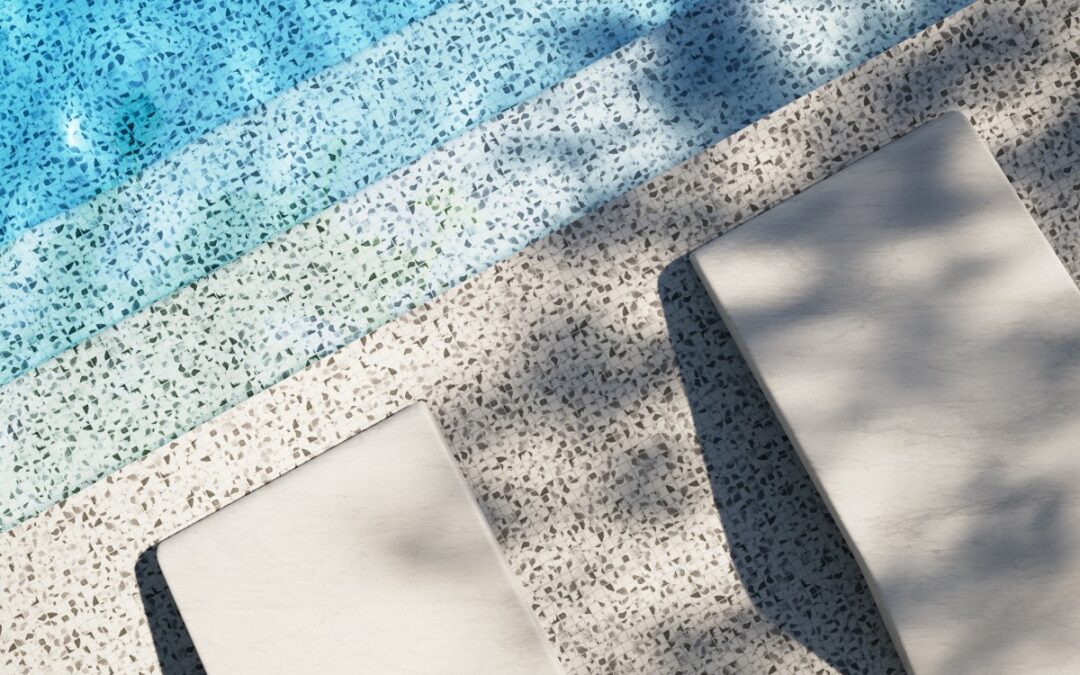
Anti-slip pool flooring outdoors needs Class 3 (Rd > 45 under UNE-ENV 12633) across every barefoot, wet-tread zone, which corresponds to an R11 ramp finish. That is the level building codes require for the perimeter, the coping and the shallow parts of the basin. Inside the basin, the reference material is glass mosaic such as Ezarri; on the deck and coping, technical porcelain from Inalco MDi or Keope in 20 mm thickness. This guide shows you how to read the slip rating, where each class applies, and what actually withstands chlorine, salts and frost.
In short
- A pool’s edge and surround require Class 3 / R11 anti-slip flooring for safety when wet.
- The pool basin (interior) is usually clad with glass mosaic (e.g. Ezarri).
- Not every porcelain works for coping and surround: choose anti-slip pieces resistant to chlorine, salt and frost.
Why does a pool edge demand Class 3 / R11?
A pool edge stacks up the three worst conditions for slipping: standing water, bare feet and a surface that often tilts toward the basin. Building regulations rank these zones as Class 3, the highest tier — slip resistance Rd above 45, measured with the friction pendulum under UNE-ENV 12633. In the trade that level is labelled R11 (DIN 51130 ramp test). Rd (pendulum) and R (ramp) are separate tests measuring the same property. R11 is the sensible minimum for coping, steps and entry; on steep falls, step up to R12.
What’s the difference between the deck and the basin?
Two environments, two materials. The deck and coping face splashing water, direct sun and barefoot traffic — large-format, 20 mm anti-slip porcelain. The basin sits permanently submerged and in constant contact with treatment chemicals — a watertight, chemically inert glass mosaic that bends around curves and steps. On the deck and shallow areas under 1.50 m (where a person stands), Class 3 is required; the deep submerged zone needs watertightness rather than grip. See our pools page.
Why is Ezarri mosaic the standard for the basin?
Because glass neither absorbs water nor reacts with chlorine. Ezarri glass mosaic has near-zero absorption, shrugs off salts, chlorine and pH swings without fading, and its tessera format clads coves, steps and overflow channels without forced cuts. For stand-up areas — steps, interior beach, shallow floors — Ezarri offers dedicated anti-slip series reaching Class 3 without giving up the glass finish. Browse Ezarri.
Will any porcelain do for the coping and deck?
No. You need technical, rectified porcelain in 20 mm with a declared anti-slip finish. That 20 mm slab carries more than four times the breaking strength of a conventional 8–10 mm tile — laid on pedestals, over gravel or glued down, taking point loads without cracking. Inalco MDi or Keope in 20 mm deliver water absorption ≤ 0.5%, frost and thermal-shock resistance, UV colour stability, and R11 surfaces cleared for the wet bare foot, resisting chlorine and salts. Find them at Inalco MDi and Keope, within porcelain flooring.
For the steps into the pool, see porcelain stair treads and stairs.
How do you read the slip classification?
Two systems run in parallel. The building-code system (UNE-ENV 12633) sorts floors into Classes 0–3 by the pendulum Rd value; an outdoor pool needs Class 3 (Rd > 45). The German ramp system uses R for shod testing (DIN 51130: R9–R13) and classes A/B/C for the wet bare foot (DIN 51097). A good pool porcelain declares Class 3, R11 and barefoot class C at once.
| R class (DIN 51130, shod) | Pendulum Rd (UNE-ENV 12633) | Building-code class | Barefoot (DIN 51097) | Recommended use |
|---|---|---|---|---|
| R9 | 15–35 | Class 1 | — | Dry interior: living room, bedroom |
| R10 | 35–45 | Class 2 | A (≥12°) | Bathroom, kitchen, covered wet areas |
| R11 | > 45 | Class 3 | B (≥18°) | Shower, pool coping and deck (outdoor) |
| R12 | > 45 | Class 3 | C (≥24°) | Ramps, slopes, access showers |
Conclusion
Anti-slip pool flooring done properly isn’t one decision but two: Class 3 / R11 across everything walked on wet and barefoot — coping, deck and stand-up areas of the basin — plus a watertight glass mosaic like Ezarri for the rest of the pool. At Gomila we stock both families and help you read each technical sheet so the declared class matches what your Mallorca project actually requires.
Frequently asked questions
- What slip class does an outdoor pool floor need? Class 3 (UNE-ENV 12633), Rd > 45; in ramp terms, R11. Applies to perimeter, coping and stand-up basin areas.
- Are R11 and Class 3 the same thing? Not exactly — two tests, same property. Class 3 = pendulum (Rd > 45), legal reference; R11 = DIN 51130 ramp. An R11 tile clears the Class 3 threshold.
- Can I use the same material in the basin and on the deck? Not ideal: basin = watertight glass mosaic (Ezarri); deck/coping = 20 mm porcelain R11.
- Does porcelain withstand chlorine and salts? Yes: ≤ 0.5% absorption, practically impermeable and chemically stable; resists frost, thermal shock and UV.
- Why is 20 mm recommended for pools? More than four times the breaking strength versus 8–10 mm: raised on pedestals or gravel, point loads without cracking.
Related: A perfect example of Class 3 slip-resistant porcelain for the pool surround is Trésor Bali by Rosa Gres.
Fond of the natural look? In our guide to stone effect porcelain tiles you’ll find collections with the R11 Soft & Safe anti-slip finish — like Sinai by Coem — perfect for pool areas.