Frequently asked questions
How thick is Fioranese stoneware?
Fioranese explains that its research and development work has brought most of its collections down to 9 mm thickness, keeping the mechanical and durability performance set out in the technical specifications for 10 mm. According to the manufacturer, the lower thickness means raw materials and energy can be used more efficiently in production, and load capacity in transport rises by around 10 % compared with 10 mm. For outdoor use it also offers formats in 20 mm.
What do the R9, R10 or R11 classes in the catalogue mean?
They are the slip resistance classification of the German standard DIN EN 16165:2021 Annex B / DIN 51130, which as Fioranese explains measures the slip resistance of flooring in work areas with slippery surfaces. The method is walking on a variable-inclination ramp, and the classification sets out five groups: R9, R10, R11, R12 and R13.
For a pool or a shower, is the R class the right one? Which classification should you look at?
For areas where people walk barefoot you need to look at classification A, B (A+B) and C (A+B+C). Fioranese states that this corresponds to standard DIN EN 16165:2021 Annex A / DIN 51097, which determines anti-slip properties in wet areas, and that the test method involves walking barefoot on a variable-inclination ramp with water running over it. The classification sets out three groups: A, B (A+B) and C (A+B+C).
Is there an anti-slip surface that is not so rough to the touch?
Yes, the Soft&Safe R11 surface. Fioranese describes it as the result of research into combining specific R11 anti-slip performance with a softer feel than the more structured outdoor surfaces. The manufacturer indicates it for outdoor surfaces and for indoor surfaces in contact with water that require specific anti-slip performance.
Can the outdoor format be laid without adhesive or grouting?
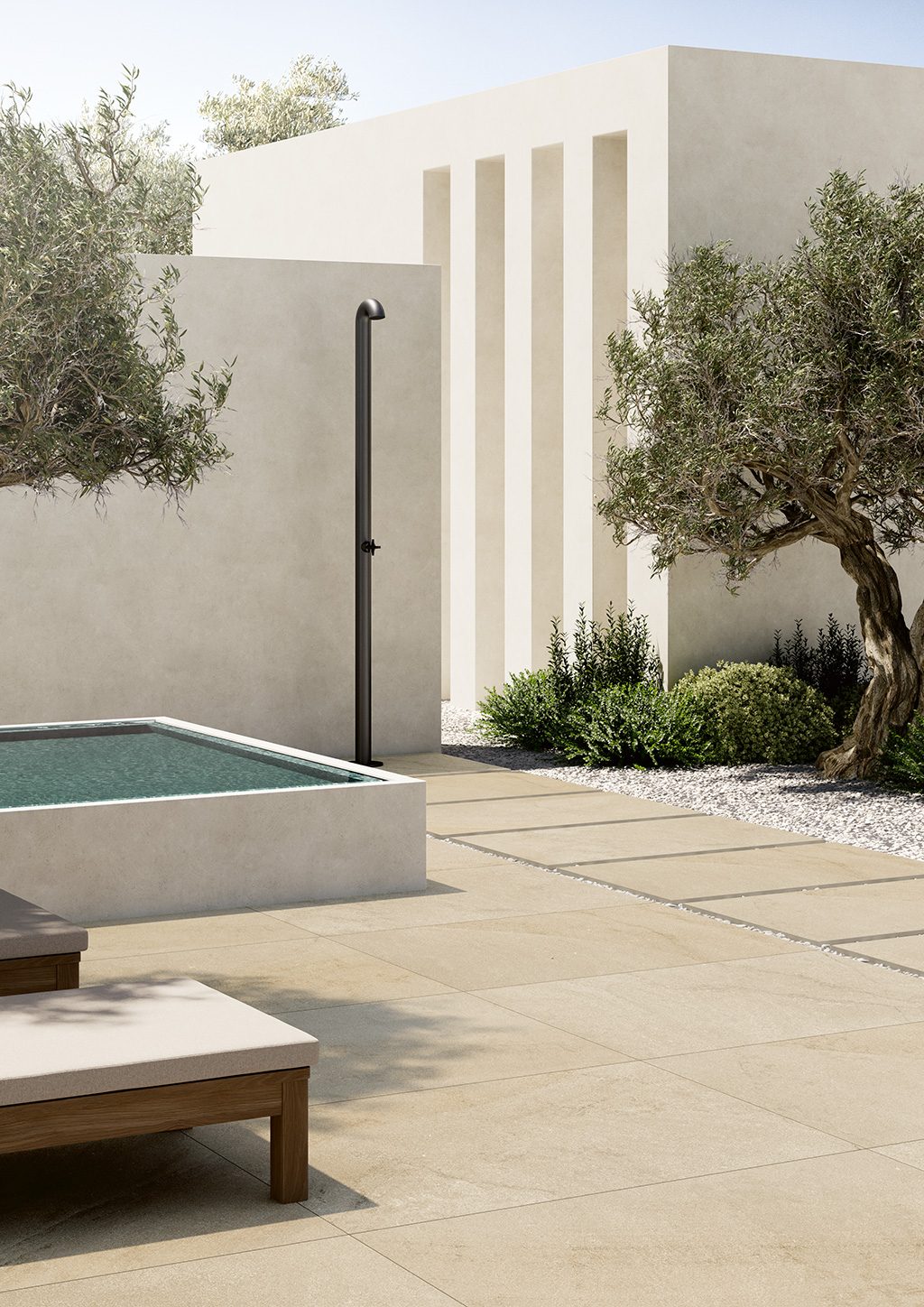
Yes. For the 2 cm thickness Fioranese describes laying on gravel or sand and on grass, both quick to carry out and with no use of adhesives or grouting material, with the advantage that the tiles can be replaced at any time without building work. On grass, the manufacturer notes that you get a path that can be walked on immediately, frost-proof and with anti-slip characteristics, easy to clean and less likely to collect dirt, mould or moss if laid and maintained correctly. In any case it refers you to the regulations of each country and to the recommendations of the substrate supplier.
What maintenance does it need once laid?
According to Fioranese, the material is easy to maintain and needs no special treatment, although the method and frequency depend on how the flooring is used and on its total surface area. The manufacturer recommends not leaving the floor dirty for long periods, always using detergent (in normal conditions a neutral or alkaline-based one is enough) and rinsing with clean water. On lapped, polished, Lux or Silk products intended for dirty areas, above all in very light and uniform colours, it advises applying a protective treatment with a product made specifically for porcelain stoneware.