Learning how to choose a shower tray is the quiet decision that shapes how your bathroom feels underfoot every single morning. It’s about far more than a pretty colour: the material sets the touch and the cleaning, the size decides whether it slots into the recess or needs cutting, and the installation — flush or raised — changes the whole sense of space. In Mallorca, where light and stone call for calm, honest bathrooms, a well-chosen tray disappears beneath your feet and lets the room breathe. This guide walks through materials, sizes, anti-slip, texture, colour and installation, with references such as Acquabella, Galassia and Cielo.
In short
- The ideal shower tray combines material (resin, ceramic/porcelain or mineral), format and anti-slip safety.
- Flush-to-floor wins on accessibility and looks; many models can be cut to size.
- Look for a Class 3 anti-slip finish for safety when wet.
Which material is best: resin, ceramic or mineral?
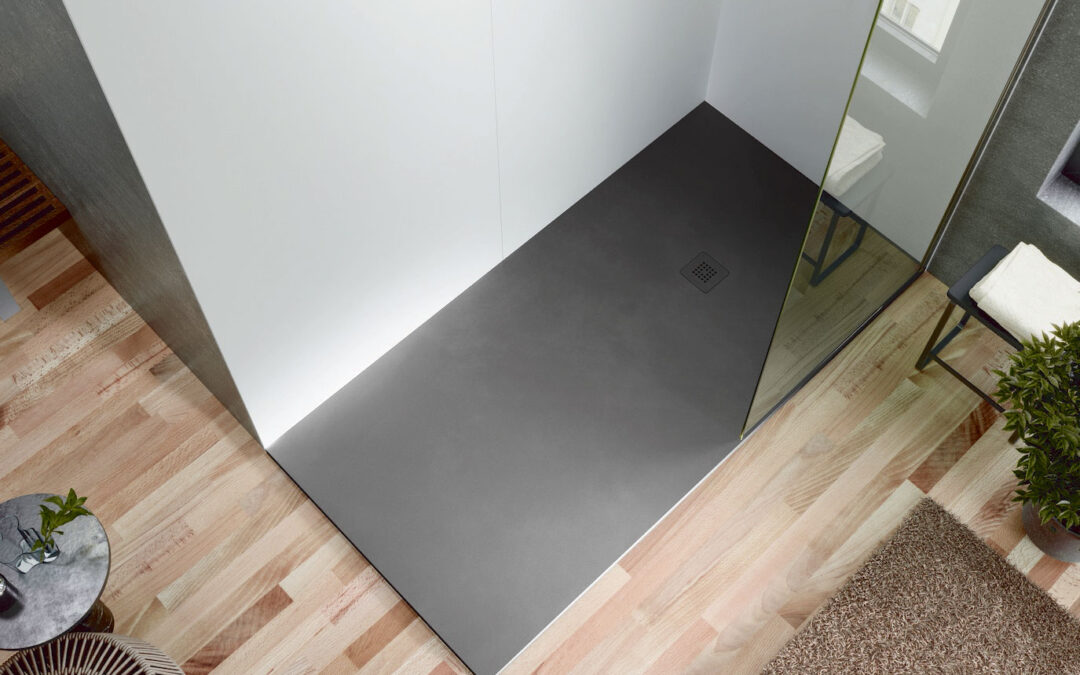
It depends on your priority, but for most modern bathrooms mineral-filled resin (the Solid Surface family) is the most balanced: resins and mineral fillers giving an ultra-flat tray, warm to the touch, impact-resistant, in slate or smooth finishes. Acquabella makes it with a certified antibacterial surface and — crucial in renovation — cut to measure. Ceramic or porcelain brings hardness and colour stability (no yellowing) and pairs with a continuous porcelain floor, though it is harder to cut and cooler underfoot. Traditional mineral-cast (reconstituted marble) is affordable and solid, with fewer textures.
Flush-to-floor or raised?
Flush almost always wins on design and accessibility: a visual continuity that enlarges the bathroom, no step, easy entry for older users. It’s what we recommend on most bathroom and spa projects. Raised makes sense when the renovation can’t lower the slab for the drain (common in older Palma flats): quicker, no heavy work, but the step returns.
How do you choose the size? Can it be cut to measure?
Measure the real recess (width, depth, drain position). Standard sizes run 70/80/90/100 cm wide, with lengths up to 160–200 cm, but few recesses are exact. The advantage of resin trays like Acquabella: they cut to measure with ordinary tools, because the silica-free composition makes cutting safe and clean, without voiding the warranty.
| Material | Advantages | Maintenance | Anti-slip |
|---|---|---|---|
| Resin / Solid Surface (Acquabella) | Ultra-flat, warm, cuttable, many colours and textures | Easy: mild soap; antibacterial | Up to Class 3 / C (maximum) |
| Ceramic / porcelain | Very hard, stable colour, matches the floor | Very easy; non-porous | Depends on glaze texture (medium–high) |
| Mineral (reconstituted marble) | Affordable, robust, stable | Easy; porous texture needs more care | Medium–high depending on finish |
What does Class 3 anti-slip mean?
Class 3 is the highest level of slip resistance and what you should look for in a shower. The CTE DB-SUA rates floors Class 1 to 3 by wet slip resistance; Class 3 is required for higher-risk wet zones. In parallel, DIN 51097 tests barefoot walking with classes A/B/C (C, from 24°, is highest). Acquabella trays reach Class 3 / C, complying with UNE-EN 14527. In everyday terms: you step onto a wet, soapy surface and your foot doesn’t skid.
How do texture, cleaning and colour come into play?
They go hand in hand. A pronounced texture (slate-style) improves grip and hides limescale but collects a little more grime; a smoother surface wipes clean in one gesture but relies on a good factory anti-slip. Today’s resins manage both, with antibacterial finishes needing only mild soap. On colour, Mallorca invites earthy tones, sand, stone grey and off-white; Galassia and Cielo carry this into basins and toilets to coordinate the whole suite.
What about installation and the drain?
Resolve the flush level and the drain before tiling. For a flush tray, plan the trap height and the fall to the outlet; a linear or integrated-grid drain keeps the look clean. Tip: decide the drain position and the waterproofing before buying the tray. If the recess is irregular, use a cuttable tray. See options in Acquabella.
Conclusion
Choosing the right tray balances material, size, safety and installation. For maximum versatility, a Class 3 anti-slip resin tray that cuts to measure fits almost any Mallorcan bathroom; if you prioritise hardness and stable colour, porcelain integrated with the floor is a great option. At Gomila we work with Acquabella, Galassia and Cielo so the result feels calm and made for your space.
Frequently asked questions
- How do I choose the right tray? Material (resin for balance, porcelain for hardness), measure the recess and drain, choose a Class 3 anti-slip rating, flush vs raised per your renovation.
- Which is easiest to clean? Resin trays with an antibacterial finish (Acquabella): mild soap and water.
- Can a tray be cut to measure? Yes: silica-free resin trays (Acquabella) cut with ordinary tools without voiding the warranty.
- What is Class 3 anti-slip? The highest wet slip resistance (CTE Class 1–3), equivalent to DIN 51097 Class C. Most recommended for showers.
- Flush or raised? Flush: more design and accessibility. Raised: simpler when the floor can’t be lowered for the drain.