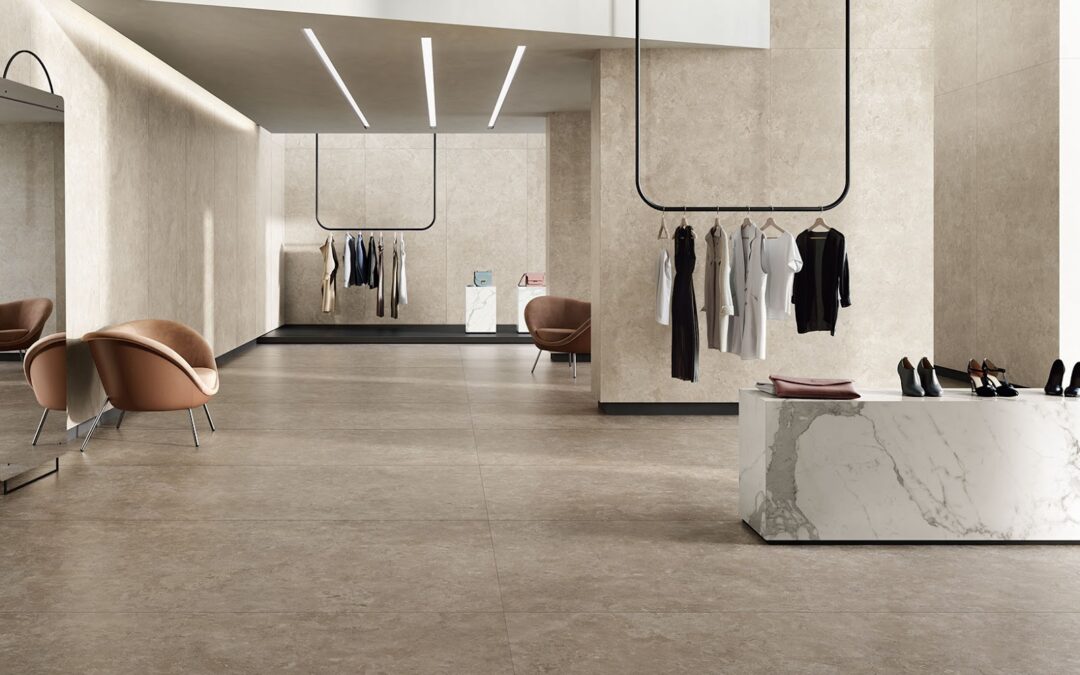
Large-format tiles have redrawn the way we think about ceramic surfaces: fewer joints, seamless expanses and a feeling of openness that transforms any room. We’re talking about pieces that begin at 60×120 cm and reach slabs of 160×320 cm, able to dress floors, walls, worktops and even ventilated façades. At Gomila we carry the leading brands — Inalco MDi, Ragno, Kronos, WOW — to guide you from choosing the right size to the final installation. In this guide we explain what actually counts as large format, its real benefits, the places where it shines, and the technical challenges worth anticipating.
In short
- Large-format tiles (120×120, 120×240, up to 162×324 cm) reduce grout lines and create continuous, spacious surfaces.
- Benefits: fewer joints (more hygienic, easy to clean), a sense of space and floor-to-wall continuity.
- Uses: floors, walls, countertops and façades; they need specialist installation.
What counts as a large-format tile?
Generally any piece whose longest side exceeds 100 cm, though the industry starts at 60×120 cm. Above that sit the big slabs: 120×120, 120×260 and up to 160×320 cm. The 60×120 is the residential flooring standard; slabs of 120×260 or 160×320 belong to technical surfaces (worktops, splashbacks, seamless walls). Inalco produces MDi slabs up to 160×320 cm in different thicknesses. “Large format” isn’t one thing but a spectrum, from the domestic floor to the architectural panel.
What are the benefits?
The most obvious: fewer joints mean a continuous surface, easier to clean and visually more spacious. Fewer joints also means fewer points where dirt and moisture collect — hygiene that is decisive in kitchens and baths. Continuity brings calm; with underfloor heating, more even warmth; on façades or worktops, entire runs with few pieces and an almost monolithic finish. Add porcelain’s versatility: resistant to scratching, staining and temperature swings, suitable indoors and out.
Where can they be used?
A cross-over material: floors, walls, worktops, ventilated façades, and cladding over existing tiles. For flooring, 60×120 and 120×120. On walls, Ragno Stratford Wall (6 mm, up to 120×278 cm). For worktops and splashbacks, Inalco MDi slabs (Lyra, Pacific, Petra) in 12 and 20 mm. On ventilated façades, technical porcelain regulating temperature. And in renovation, cladding over existing tiles with 6 mm pieces, no demolition. Browse porcelain flooring, Inalco MDi and Ragno.
On a shower floor, large format depends on the drain: we explain it in walk-in and level-access showers.
What thicknesses are available?
6 to 20 mm by use: 6 mm for walls and cladding over old tiles; 9-12 mm for interior floors; 20 mm for outdoor and heavy-duty worktops. The 6 mm is light and overlayable; 9-12 mm is the flooring standard; 20 mm suits adhesive-free outdoor use (dry-laid on gravel or pedestals), vehicle access and worktops resisting impact and heat.
| Size (cm) | Ideal use | Typical thickness |
|---|---|---|
| 60×120 | Interior residential and commercial flooring | 9-12 mm |
| 120×120 | Seamless floors, large rooms | 9-12 mm |
| 40×120 / 60×120 | Wall cladding (Ragno Stratford Wall) | 6 mm |
| 120×278 | Jointless walls, full runs | 6 mm |
| 120×260 / 150×320 | Worktops and splashbacks (Inalco MDi) | 12 mm |
| 160×320 | Architectural slabs, premium worktops, exterior | 12-20 mm |
What are the installation challenges?
More planning and expert hands. Setting out matters (layout, joints, substrate flatness; a large slab is unforgiving of unevenness, so use a level base and levelling clips). By weight, two installers are needed and, for the largest slabs, handling frames or suction cups. The adhesive should be high-performance (C2 or above) with back-buttering (trowel on both substrate and tile) for full contact and no voids. These are standard for a qualified installer; at Gomila we help you plan for them.
Conclusion
Large-format tiles deliver continuous, clean, luminous surfaces. From 60×120 cm for a serene floor to 160×320 cm slabs for worktops and façades, the range covers almost any project. The key is choosing the right size and thickness, and trusting installation to expert hands. At Gomila we carry the finest brands and guide you through every decision.
Frequently asked questions
- From what size is a tile large format? From 60×120 cm; big slabs from a side over 120 cm, up to 160×320 (Inalco MDi).
- Can it be laid over existing tiles? Yes: 6 mm pieces over a sound, clean, level substrate, no demolition.
- What thickness for a kitchen worktop? 12 or 20 mm (Inalco MDi range): resistance to scratching, heat and impact.
- Suitable for outdoors in Mallorca? Yes: 20 mm porcelain, dry-laid on pedestals or gravel, copes with moisture, sun and temperature swings.
- Do I need a specialist installer? Highly recommended: set-out, two installers, levelling clips and back-buttering with a C2 adhesive.