Understanding what is zellige means getting to know one of the oldest, most sensory tiles in Mediterranean design. Zellige is a handmade glazed terracotta tile, born in Fez, Morocco more than a thousand years ago, where every piece is shaped, cut and glazed one by one. Its charm lies in the irregular: the uneven sheen, the shifting colour, the gentle relief. In a Mallorcan home, a run of zellige brings a warm, artisanal quality that Mediterranean light knows how to flatter. In this guide we walk through its origins, its characteristics, where to use it and how to lay it well.
In short
- Zellige is a handcrafted Moroccan tile, hand-glazed, with irregularities and sheen that give it character.
- Each piece is unique (tone, relief), creating living, textured surfaces.
- Ideal for kitchen backsplashes, bathrooms and accent walls.
What is zellige, and where does it come from?
Zellige is a glazed, kiln-fired clay tile, made entirely by hand following a tradition barely changed in a thousand years. It was born in Fez (northern Morocco) around the 10th century; its name comes from Arabic, evoking a “little polished stone”. For centuries it clad the courtyards, fountains and palaces of the Islamic world. The process is handcrafted: natural Fez clay is shaped, sun-dried and fired in traditional kilns; each tile is then glazed by hand (dipped or brushed) and returned to the kiln. That piece-by-piece handling gives zellige its singular character: no two tiles are ever quite the same.
What are the characteristics of authentic zellige?
It’s recognised by its deliberate irregularity: never perfectly flat, colour shifting from tile to tile, glaze with brighter and softer patches, sometimes with fine hairline cracks (crazing). Not flaws — the signature of handwork. Traits: irregular surface and thickness (crisp edges catching the light); colour and tonal variation; uneven sheen and relief (reflections changing through the day); crazing; dimensional differences of millimetres. Under warm Mediterranean light, a zellige wall never looks the same at nine in the morning as at dusk.
Authentic zellige or zellige-effect: which should I choose?
It depends on the project. Authentic offers unmatched character, but more variation, more wastage and a more demanding installation. Industrial “zellige-effect” reproduces that feel with calibrated, stable, easy-care pieces. At Gomila we work with both: WOW Bejmat (drawn from the Moroccan *bejmat*, the rectangular piece that once paved floors and courtyards) and WOW Roots recreate the texture, lively sheen and tonal variation of handwork. Explore them within the WOW collection.
| Feature | Handmade zellige | Zellige-effect (porcelain/ceramic) |
|---|---|---|
| Material | Hand-glazed terracotta | Porcelain stoneware or industrial ceramic |
| Origin | Morocco (Fez), ancient tradition | Industrial production (WOW, Spain) |
| Calibration | Non-calibrated, variable sizes | Calibrated, consistent sizes |
| Colour variation | Very high, piece by piece | Controlled, intentional |
| Crazing and relief | Natural and irregular | Uniformly reproduced |
| Installation | Demanding, minimal or butt joint | Straightforward, regular joint possible |
| Durability / heavy use | More delicate | High, suitable for floors and wet areas |
| Maintenance | Needs sealing and care | Low maintenance |
Where should you use zellige at home?
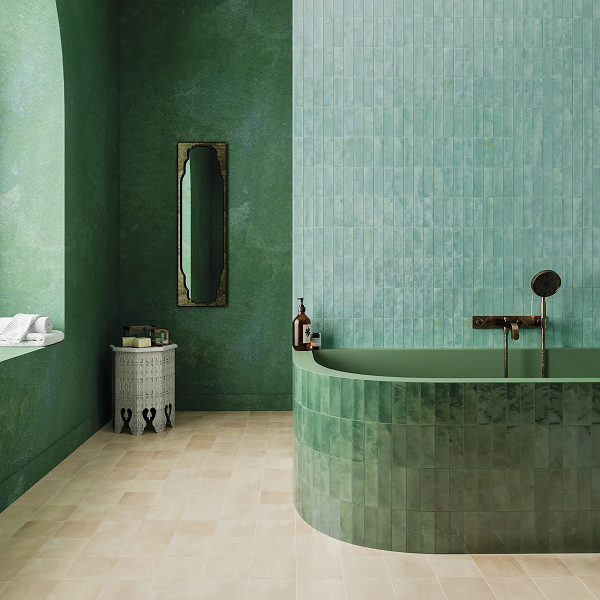
Zellige shines on vertical surfaces at eye level, where its texture is appreciated up close: kitchen backsplashes, bathroom walls and accent walls; in porcelain, also floors and high-traffic areas. Uses that work in a Mediterranean home: kitchen backsplashes (between worktop and upper units), bathrooms and showers (full walls or an accent panel playing with steam and light), accent walls (a fireplace, an entrance hall, a bedroom headboard wall), outdoors and porches (with suitable porcelain pieces).
How is zellige laid correctly?
It calls for method and a steady hand. Because pieces vary — especially the authentic — mix boxes before starting, dry-lay the layout, and work with a minimal or butt joint. With calibrated zellige-effect, a fine regular joint is enough. Key points: 1) Mix pieces (combine boxes to spread variation); 2) Minimal or butt joint (traditional almost jointless; porcelain accepts a fine joint); 3) Laying direction (horizontal, vertical or herringbone — sets the rhythm); 4) Adhesive and trowel (flexible cement-based adhesive, keeping level despite irregularities); 5) Grouting (a related grout colour so the surface reads as continuous). Advice: for authentic zellige, work with an installer experienced in handmade tile.
How do you maintain zellige?
Depends on the type. Porcelain zellige-effect cleans like any stoneware: water and neutral soap. Handmade zellige, more porous, benefits from an initial seal and gentle products that respect the glaze. Avoid abrasive cleaners and metal scourers, and wipe splashes in wet areas.
Conclusion
Understanding what zellige is means discovering how a piece of glazed clay, made by hand in Fez, still stirs something a thousand years on. Its irregularity, its shifting sheen and its relief are exactly what make it feel alive — especially under Mediterranean light. Whether you’re after the authenticity of handmade zellige or the reliability of porcelain zellige-effect, the key is choosing the right piece and laying it with craft. At Gomila we’ll help you find the right option for your kitchen, bathroom or accent wall in Mallorca.
Frequently asked questions
- What exactly is zellige? A handmade glazed terracotta tile from Fez, Morocco, over a thousand years old; each piece shaped, cut and glazed individually.
- Why does zellige have so many irregularities? Because it’s made by hand: colour variation, uneven sheen, relief and crazing are the signature of the craft, not flaws.
- Difference between authentic and zellige-effect? Authentic = handmade glazed terracotta, variable sizes, demanding install. Effect = calibrated ceramic/porcelain mimicking the look with more stability and durability.
- Can it be used on floors and wet areas? Handmade is delicate (best for walls); for floors/showers/outdoors, porcelain zellige-effect.
- With a joint or butt-jointed? Traditional butt-jointed or minimal joint; calibrated effect accepts a fine regular joint. Mix boxes and dry-lay first.