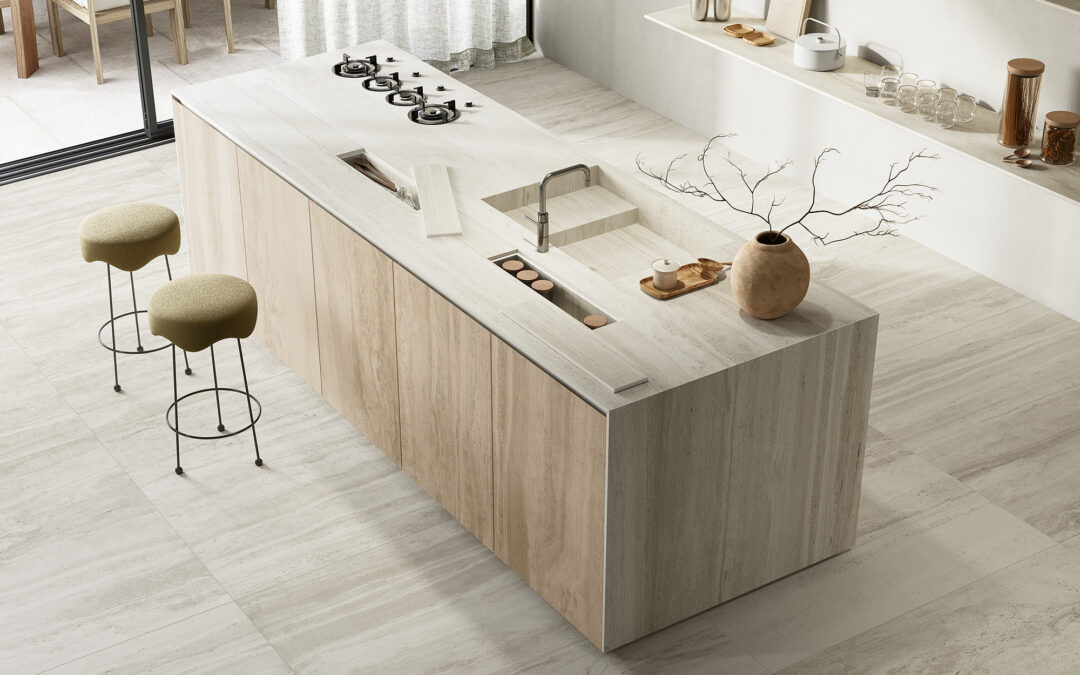
The countertop has become the centrepiece of the kitchen, and large-format porcelain is today one of the most sought-after materials for making it. There is good reason for this: it brings together the beauty of natural stone with a set of technical qualities that no classic material offers all at once. In this guide we explain what a porcelain countertop is, its advantages over quartz, granite or marble, the factors that shape its price, and how to choose the right one for you.
In short
- A porcelain countertop is a large-format porcelain stoneware surface (12 mm or more) for kitchens — tough and very easy to maintain.
- It resists heat (no visible effect up to ~200 °C), won’t scratch or stain, is food-safe and doesn’t absorb water.
- The two main options we work with are Coem’s IMMENSA (162×324 cm, 12 mm reinforced with a high-resistance mesh) and Inalco’s MDi.
- Key choices: effect (stone or marble), colour, thickness and edge — Smart Edges are worked like natural stone.
- Versus quartz, granite or marble, it handles heat and scratching better and needs no sealing.
What is a porcelain countertop?
It is a countertop made from large porcelain slabs — a ceramic material fired at high temperatures and extremely dense — usually in large format (up to 162 × 324 cm) and 12 mm thick (or 6 mm for wall cladding). Because it is a full-body slab (the same material all the way through its thickness), the edges can be finished on show just as they are with natural stone, for a continuous, refined finish.
Compared with smaller formats, large format carries the veining further, keeps joints to an absolute minimum and creates a sense of openness that is hard to achieve with other materials. (If you want to go deeper, we have a dedicated article on large-format porcelain.)
Benefits of a porcelain countertop
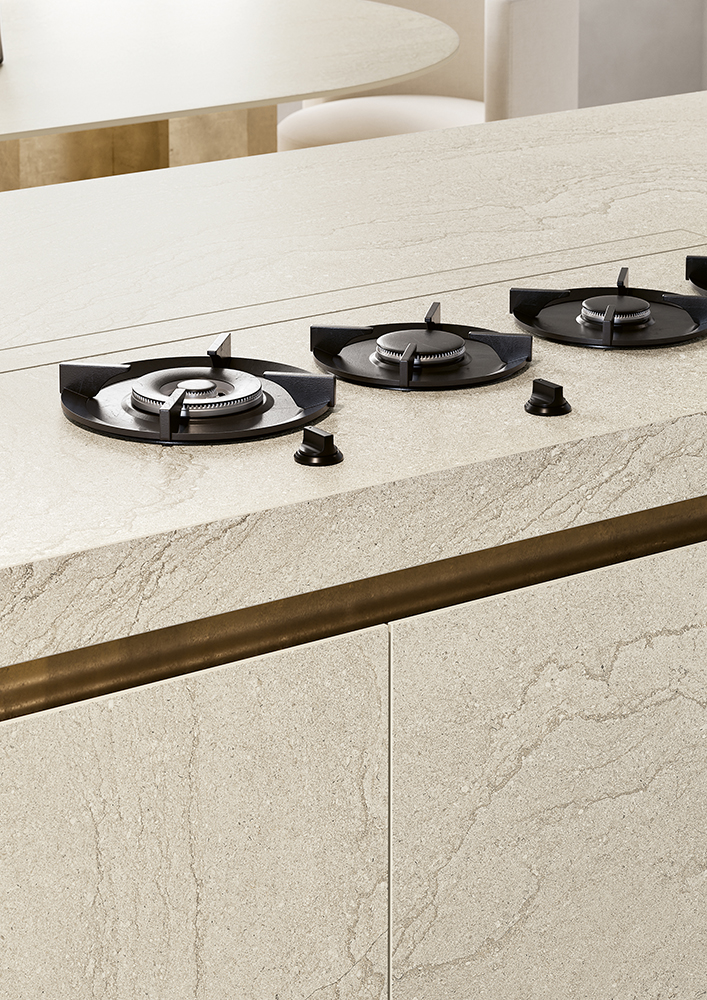
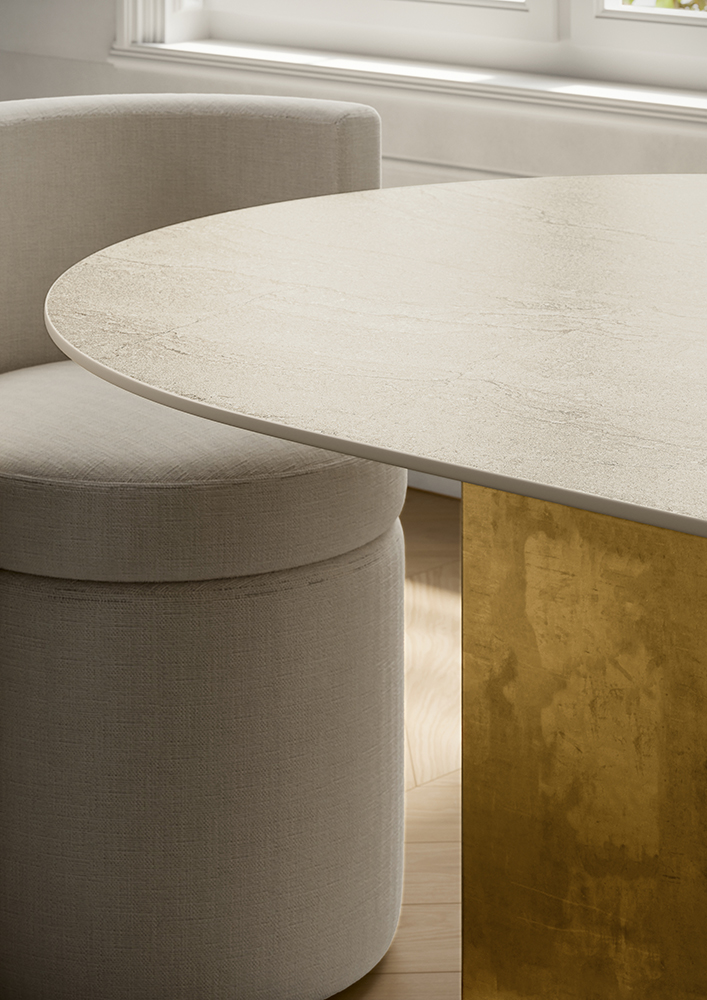
- Heat resistant: no visible effect up to around 200 °C — you can set a hot pan down without worry (within reason).
- Non-absorbent: it does not take in water or liquids, making it hygienic, odourless and safe for contact with food; it holds no stains from coffee, wine or oil.
- Highly resistant to scratching and abrasion: it stands up to intensive kitchen use.
- Resistant to the chemicals, acids and solvents used in everyday cleaning.
- Complete colour stability: it does not fade or change over time or with exposure to light.
- Suitable for outdoors: resistant to frost, temperature swings and UV rays, ideal for outdoor kitchens and utility areas.
- Versatile aesthetics: finishes with a stone, marble, cement or wood effect, from matt to satin, to suit any style.
- Seamless large format across the work surface, with continuity onto the splashback or front.
How much does a porcelain countertop cost?
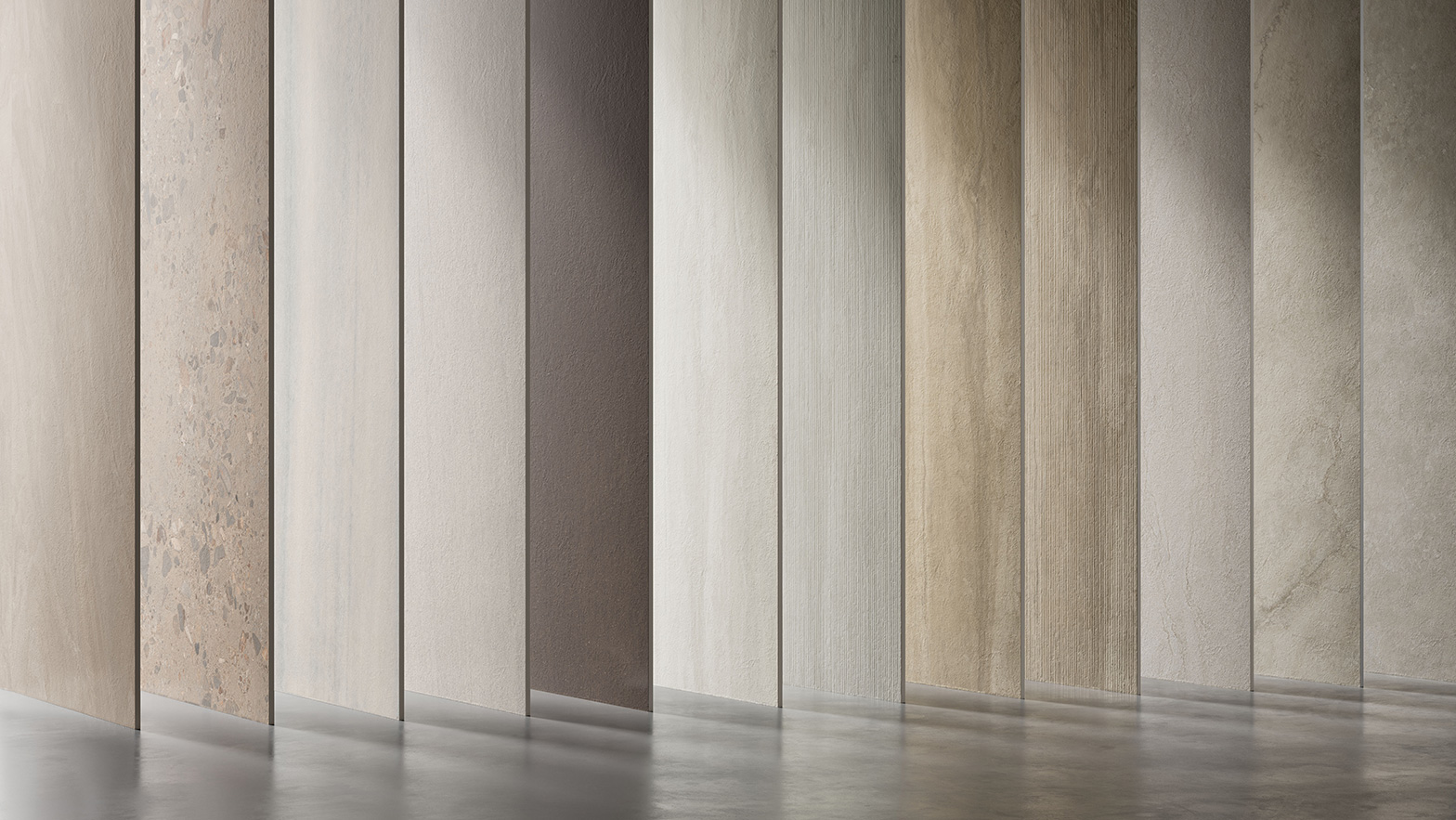
There is no single price: it depends on several factors. The main ones are:
- Format and thickness (12 mm for a countertop; large format optimises cuts and joints).
- Finish and collection (the more elaborate marble and stone effects come at a different cost).
- Edge work (exposed edge in the Smart Edges style, mitred, and so on).
- Bespoke fabrication and installation (measuring, sink and hob cut-outs, transport).
As a positioning reference, porcelain typically sits in a range similar to quartz (Silestone) and below or on a par with premium surfaces such as Dekton or Neolith, and it usually makes up for it with minimal maintenance over the years. The most reliable approach is to request a bespoke quote based on your kitchen and your chosen collection.
How to choose your porcelain countertop
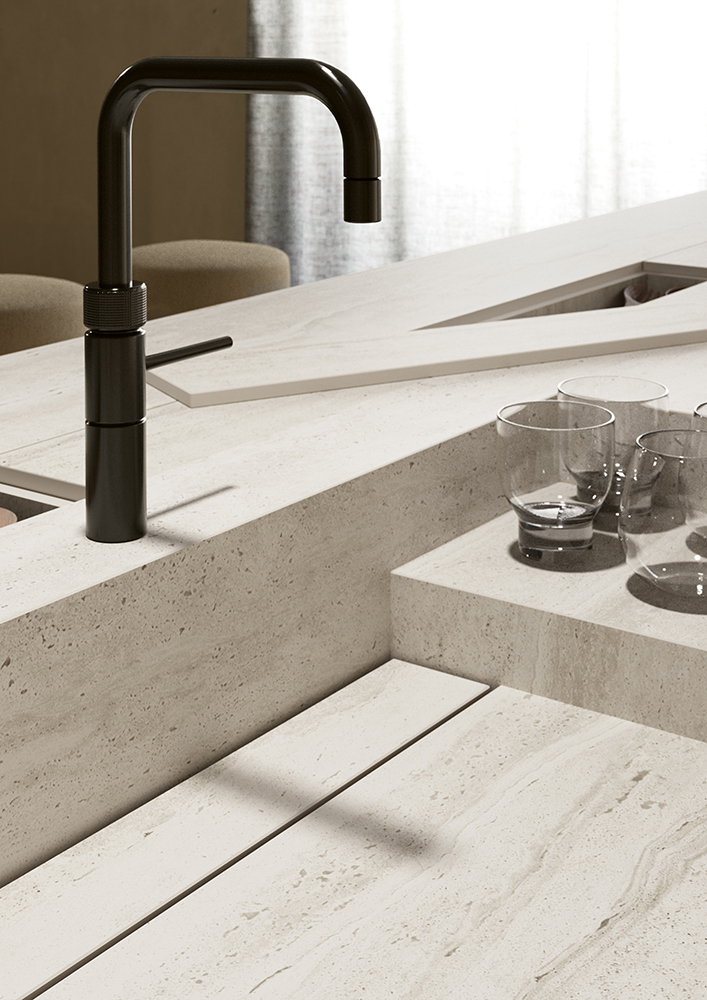
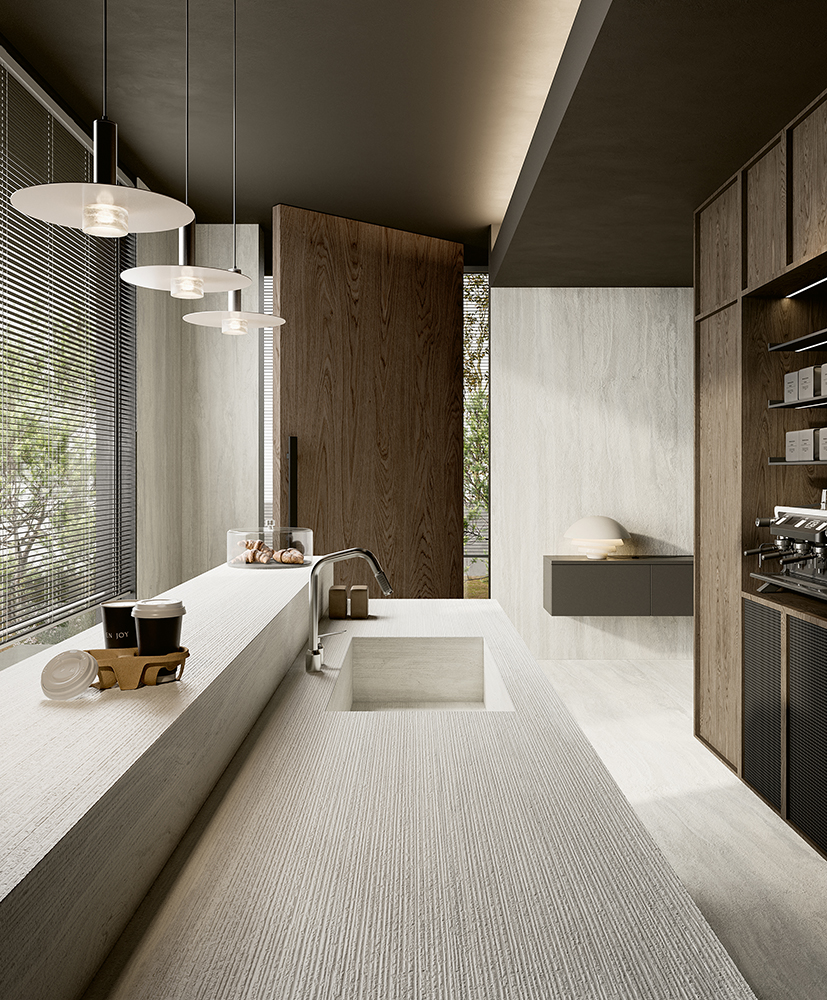
Four decisions shape the result: the effect, the colour, the thickness and the edge.
The effect: what each one brings
Porcelain reproduces almost any material today, and each effect has its own character:
- Marble effect — luminosity and classic elegance; the most aspirational look (veining included) but without the fragility of real marble.
- Stone / travertine effect — warmth, a natural feel and depth of texture; ideal for serene, warm settings.
- Cement / microcement effect — an industrial, minimalist aesthetic with a uniform surface.
- Wood effect — the warmth of wood without its upkeep (less common on a countertop than on a floor, but possible).
Beyond style, there is a practical nuance: veining and texture hide everyday use (fingerprints, crumbs, drops) better than a plain, perfectly uniform tone.
The colour: light, character and practicality
- Light tones (whites, creams, beige) open up the space, bring in light and are timeless; they also forgive dust and water marks better.
- Dark tones (graphite, mocha, black) add character and sophistication, but show fingerprints and dust more on very smooth finishes.
- Warm vs cool: creams and beiges bring warmth (pairing with wood and brass); greys give a more contemporary, neutral feel.
The thickness: the key decision
This is the one most people ask about. For a porcelain countertop you are essentially choosing between three options:
- 6 mm — lightweight. Reserved for cladding, fronts and splashbacks, or for countertops with a reinforcing substructure. Less weight and less cost, but it cannot take an exposed edge.
- 12 mm — the countertop standard. It brings sturdiness —reinforced with a high-strength mesh— and, being full-body, it allows the exposed edge (Smart Edges) to be worked like natural stone. The ideal balance for most kitchens.
- 20 mm (or a thicker-look finish) — for a solid, imposing look, outdoor countertops or projects that call for a sense of substance. That thickness can also be achieved with a thinner slab and a mitred edge that mimics the mass.
In a nutshell: the thicker it is, the greater the sense of solidity and the better the exposed edge; the thinner it is, the lighter and less costly, made more for cladding than for the work surface.
The edge: the finish changes everything
- Straight — the cleanest and most contemporary; understated and economical.
- Mitred (45° mitre) — joins two pieces at an angle to suggest a great thickness (4–6 cm or more) with a thin slab: a solid look without the weight.
- Exposed edge / Smart Edges — makes the most of the full body of the 12 mm: it is polished and profiled like natural stone, with the same material and the same veining on the edge. A continuous, refined finish.
- Softened profiles (bevelled or rounded) — for a warmer touch that is gentler to the hand.
The finish and continuity
- Finish: matt (understated, warm, hides fingerprints) or satin/polished (more luminous, with more depth of veining).
- Continuity: consider carrying the same material onto the splashback or front — even onto the table — for an enveloping effect (see our article on kitchen fronts).
Porcelain compared with other materials (summary)
| Property | Porcelain | Quartz (Silestone) | Granite | Marble |
|---|---|---|---|---|
| Heat resistance | Very high (~200 °C) | Medium (sensitive) | High | Medium |
| Absorption / staining | Non-absorbent | Low | Medium (porous) | High (porous) |
| Scratching | Very resistant | Resistant | Very resistant | Sensitive |
| Outdoors / UV | Suitable | Not recommended | Suitable | Sensitive |
| Maintenance | Minimal | Low | Medium (sealing) | High |
For a material-by-material breakdown, see the comparison “Porcelain countertop vs quartz, granite and marble”; and if you are torn between porcelain and Dekton, we have a dedicated article on that.
Gomila’s porcelain countertops
At Gomila Cerámica we work with large-format porcelain for countertops from two leading names:
- IMMENSA by Coem — the Italian large format (162 × 324 cm, 12 mm) with a stone effect and an exposed edge (Smart Edges). Distributors of Coem in the Balearic Islands.
- Inalco (MDi) — the large-format (160 × 320 cm) line from Inalco, in thicknesses of up to 12 mm. It brings together several stone-effect collections — Amara (born of Binissalem stone, Mallorca), Ananda, Atalaia, Lyra, Pacific and Petra — from a sandstone look to limestone.
Come and see them, and touch them, in our showroom, or write to us and we will advise you on your project. gomila-ceramica.com
Frequently asked questions
What advantages does a porcelain countertop have over quartz or granite?
It resists heat better (no visible effect up to ~200 °C), does not absorb liquids or stain, stands up to scratching and is suitable for outdoor use. Maintenance is minimal.
Is a porcelain countertop heat resistant?
Yes. Porcelain shows no visible effect up to around 200 °C, so it easily withstands the everyday heat of the kitchen.
Does porcelain scratch or stain?
It is highly resistant to scratching and, being non-porous, it does not absorb liquids or hold stains from coffee, wine or oil.
How much does a porcelain countertop cost?
It depends on the format, thickness, finish, edge work and bespoke installation. It sits in a range similar to quartz; the best approach is to request a quote based on your kitchen.
Can porcelain be used in an outdoor kitchen?
Yes. It is resistant to frost, temperature swings and UV rays, which makes it ideal for outdoor kitchens.