In short
- A kitchen does not have one tile: it has five surfaces, each with different demands. The floor, the splashback behind the hob and sink, the remaining walls, the worktop and, if the kitchen is open-plan, the transition to the living room.
- For the floor, porcelain stoneware (water absorption ≤ 0.5%), in a matt or satin finish, with a reference slip resistance of R10 / Class 2, because a kitchen floor gets wet and oil gets spilt on it.
- On the splashback, cleaning comes first: few joints behind the hob, good-quality grout and surfaces that do not hold on to grease. Zellige and relief tiles work best where there is less splashing.
- The remaining walls are the free zone: this is where colour, pattern and ceramic wallpaper belong.
- If the kitchen opens onto the living room, the right call is one floor with no breaks, and choosing the kitchen wall tiles from there. You can see the collections at our showroom in Palma, Carrer de Calçat, 16.
Choosing kitchen tiles usually starts with an image: a green zellige splashback, a pale stone floor, an island that looks carved from a single block. And it is right that it starts there. But a kitchen is not one surface, it is several, and each one works in its own way. The floor takes the water and oil that fall on it; the wall behind the hob, the heat and the greasy steam; the worktop, all of it at once. What is perfect in one place can become a small daily annoyance in another.
This guide walks through the kitchen area by area, in the order in which the decisions are made, and ends with a table to keep at hand when you visit the showroom.
One kitchen, five different surfaces
Before talking about collections, it helps to break the kitchen down into its parts. Not to complicate it, but because each area asks something different of the material, and knowing that makes the choice simpler:
- The floor: foot traffic, dropped objects, stains, water and grease, and continuity with the rest of the house.
- The splashback, that is, the strip of wall between the worktop and the wall units: heat, steam, splashes and constant cleaning.
- The remaining walls: few technical demands, a lot of visual presence.
- The worktop: the working surface, with its own rules (and its own articles).
- The transition to the living room, when the kitchen is open-plan.
The kitchen floor
It is the hardest decision to change later, and the one you notice most every day. If you are unsure what flooring to put in the kitchen, start here.
Stains, grease and water: why porcelain
Everything ends up on a kitchen floor: oil, wine, coffee, tomato, water from the sink. The property that deals with it is water absorption. Porcelain stoneware absorbs ≤ 0.5% of its weight: the stain stays on the surface and comes off with the mop. A more porous material lets it in, and what gets in does not come out. If you are hesitating between glazed stoneware and porcelain, we explain it calmly in stoneware or porcelain: which to choose for each use.
The finish matters as much as the material. A high-gloss polished finish is beautiful in a living room, but in the kitchen it shows every drop, every footprint and every step taken with damp feet. For kitchen floor tiles, the sensible choice is a matt or satin finish: it looks just as refined and is far more forgiving.
Slip resistance: the right balance
A kitchen is a wet area even if it does not look like one. Water beside the sink, oil next to the hob, someone coming in barefoot from the garden. The usual reference for a kitchen floor is R10 on the ramp scale and Class 2 under the Spanish building code, which requires it in kitchens for public use and which works as a good reference in homes.
It is not worth overdoing it either. A very rough surface grips more, but it also holds grease and is harder to wash, which is exactly the opposite of what you want in a kitchen. The full explanation of the scales, with their equivalences, is in our guide to R9, R10, R11 and slip ratings.
Format, colour and grout
Format. The fewer the joints, the fewer the places where dirt builds up. Large, rectified formats leave a minimal joint and give a continuous plane that makes the kitchen feel larger. You will find the sizes and uses in large-format tiles. In small kitchens or those with many cuts (islands, pillars, L-shaped units), a medium format can resolve the junctions better.
Colour. Extremes become tiring in a kitchen: pure white shows every crumb and black shows every dried drop and every limescale ring, something you notice in Mallorca, where the water is hard. Mid tones with a little movement (sand, greige, warm stone, natural wood) keep a visual calm through the real life of a home.
Grout. The weak point of any kitchen floor is the joint, not the tile. Good-quality grout, in a shade close to the tile and never white, makes the difference two years on. The general criteria for grout and setting out are in how to choose porcelain flooring for each room, where the kitchen has its own section.
One last planning detail: if the floor runs underneath the units, changing the layout one day does not mean redoing it. It is a conversation worth having with whoever will carry out the work before it starts.

The splashback: the hob and the sink
The splashback is the hardest-working wall in the kitchen. Here the question is no longer whether it is slippery, but whether it cleans. We covered the style ideas (zellige, stone, microcement) in ceramic kitchen splashbacks: ideas in zellige, stone and microcement. Here we deal with the technical side.
Behind the hob
Behind the hob there is heat, steam and a thin film of grease that settles day after day. Ceramic resists it well: it does not warp with heat or absorb oil. What decides whether that wall looks clean in five years is something else: the number of joints and the texture of the surface. A smooth or satin surface with few joints wipes clean in one pass. A pronounced relief or a wide joint holds grease, and grease holds dust.
That is why, behind the hob, large format works especially well (one or two pieces and hardly any joints), as does the worktop material continuing up the wall.
Beside the sink
At the sink the enemy is water, and in Mallorca, water full of lime. White rings show more on dark tones and high-gloss surfaces. Good-quality grout and an impermeable material do the rest. Here the splashback also works as protection: it should reach as far as the tap really splashes, not just as far as looks pretty.
Zellige, gloss or large format
Zellige is one of the most beautiful tiles you can put in a kitchen, with its living surface and its irregular reflections. It has a handmade character that is a pleasure to live with, and also joints and small irregularities that, behind the hob, call for more cleaning. If you love it, do not give it up: place it where there is less splashing, or accept that gaining a patina is part of its charm. We explain it in what zellige is.
Gloss tiles and small formats (metro, hexagon, elongated rectangle) are the classic choice for kitchen splashback tiles: they clean well and reflect light, which is welcome in a kitchen with a small window. Large format, on the other hand, is the most serene option and the easiest to maintain.


The remaining walls
Away from the splashback, kitchen walls barely suffer. This is the area where ceramic can stop being protection and become an aesthetic decision: a half-height dado in the breakfast area, a whole wall in colour, a relief that plays with raking light, or a floral motif.
This is exactly where ceramic wallpaper makes sense: decorative porcelain that dresses the wall like wallpaper, but withstands steam and cleans with water and neutral soap, which is precisely what real wallpaper cannot cope with in a kitchen.
The rule that puts everything in order is simple: only one star. If the splashback is green zellige, the other walls stay quiet. If the star is a decorated wall, the splashback becomes discreet.
The worktop, in brief
The worktop deserves an article of its own, and it has four. In short: large-format porcelain has become one of the reference materials for the working surface because it does not absorb liquids, does not hold stains and withstands heat with no visible effect up to around 200 °C. Lines such as IMMENSA by Coem (162 × 324 cm slabs, 12 mm thick, reinforced with mesh) are designed precisely for worktops.
To decide at your own pace:
- What it is, its advantages and how to choose it: porcelain worktops: a guide.
- Compared with other technical surfaces: porcelain worktop vs Dekton vs quartz.
- Compared with the classic materials: porcelain, quartz, granite or marble.
- How it behaves over the years: porcelain worktop durability and care.
What does matter for this article is the relationship with the splashback: if the worktop rises up the wall in the same material, the splashback is resolved in the cleanest way possible.
Open-plan kitchen: a single floor
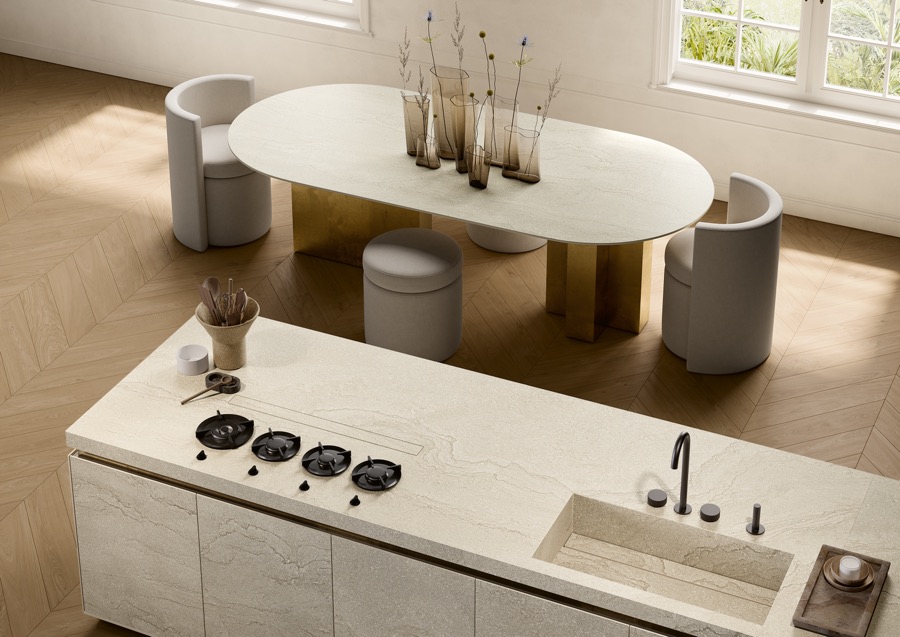
When the kitchen opens onto the living room, the floor stops belonging to the kitchen and starts belonging to the house. The most common mistake is to change flooring at the edge of the kitchen: visually it splits the space in two exactly where you wanted to join it.
The most serene solution is one continuous floor, laid in the same direction, and let that floor meet the demands of the kitchen (porcelain, matt finish, R10). In practice, open-plan kitchen flooring usually leads to two families:
- Wood effect, for those who want the warmth of a living room without the worry of real wood next to the sink. We compare them in depth in wood-effect porcelain versus parquet.
- Stone or cement effect in large format, which gives a continuous plane and leaves the leading role to the furniture and the island.
Once the floor is decided, the kitchen wall tiles are chosen from it, not the other way round. You will find examples of integrated kitchens in inspiration for kitchens open to the living room.
What to ask of the material in each area
| Area | What to ask of the material | Typical porcelain or ceramic option |
|---|---|---|
| Floor | Absorption ≤ 0.5%, R10 / Class 2, a finish that forgives stains and footprints | Matt or satin porcelain, stone, cement or wood effect, medium or large format |
| Hob splashback | Resistance to heat and grease, few joints, easy-to-clean surface | Large format or the worktop continued up the wall; smooth or satin tile |
| Sink splashback | Impermeable, does not show limescale, good-quality grout | Porcelain or glazed tile in a mid tone; zellige if you accept its patina |
| Remaining walls | Aesthetics and occasional cleaning | Decorative tile, relief, colour, ceramic wallpaper |
| Worktop | Heat, scratches, stains, contact with food | 12 mm large-format porcelain |
| Open-plan kitchen | Continuity with the living room without losing kitchen performance | A single matt porcelain across the whole floor, wood or stone effect |
Collections that work in a kitchen
These are some of the collections we carry that suit the areas in this article. You can see them all at the showroom and in porcelain flooring.
For the floor.
- Ragno · Realstone_Argent, stone in warm tones with StepWise anti-slip technology, in several formats, thicknesses and colours for coordinated floor and wall projects. And Stratford, a matt surface with StepWise and a wide palette of neutral tones.
- Kronos · Les Bois, a wood effect that reproduces the texture and tonal variation of wood, suitable indoors and outdoors.
For the splashback and walls.
- WOW · Bejmat, a tribute to the handmade tile, with slightly variable dimensions and designed to dress everything from patios to kitchens.
- Ragno · Glacé, a three-dimensional structure and clay tones inspired by 1980s artisan ceramics; Gleeze, gloss surfaces with concave and convex shapes; and Papers, a wall tile inspired by wallpaper.
- Atlas Concorde · Marvel Pro, a marble effect with a gloss surface, easy to clean and resistant to stains and chemicals.
- Vallelunga · Bloom and Grandiosa, floral and botanical motifs that unfold across the wall like ceramic wallpaper.
For continuity across floor, wall and worktop.
- Keope · Ikon, a cement effect in Gris, Beige, Silver and White, with a maxi format of 120 × 278 cm and 6 mm to cover floors and walls seamlessly.
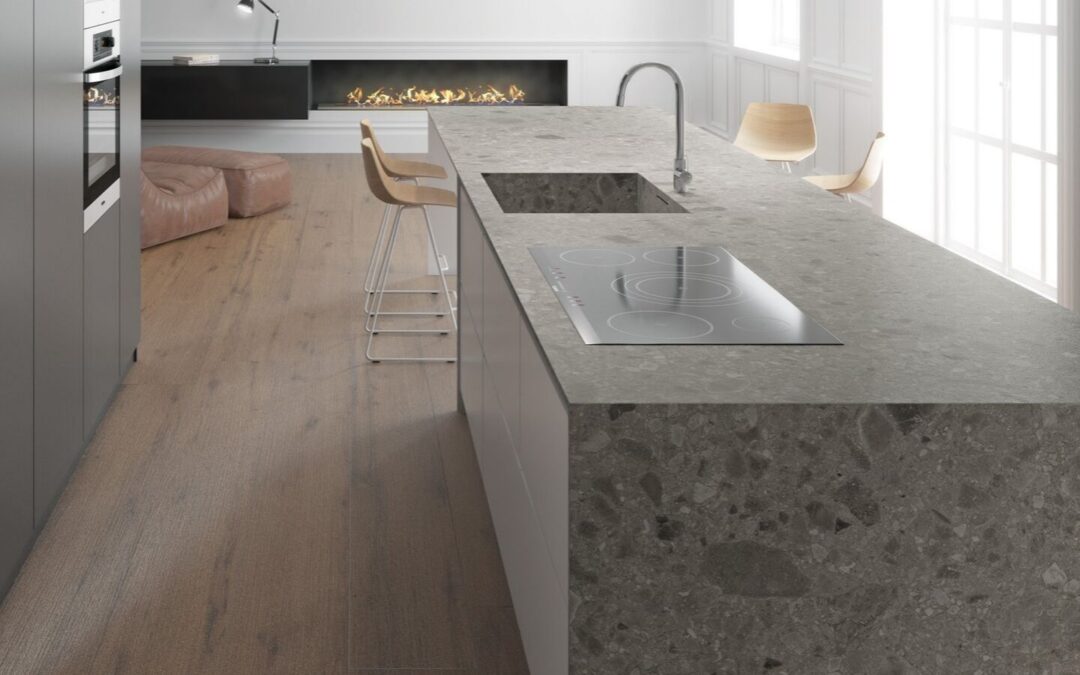
- Inalco · Amara, a cream finish with a natural relief that recalls Mallorcan stone, for worktops, floors and walls, indoors and outdoors.
- Coem · IMMENSA for the worktop, bringing the brand’s stone-effect surfaces, such as Sinai or Travertino Reverso, to the working surface.
Where to see it in Palma
Kitchen tiles need to be seen together: the floor sample next to the splashback sample and the worktop, in natural light. It is the only way to know whether they get along. At our showroom you can put that composition together at your own pace, and bringing a photo or a plan of your kitchen helps a great deal.
Gomila Cerámica
Carrer de Calçat, 16 · 07011 Palma (Mallorca)
Tel. 971 732 343 · info@gomila-ceramica.com
Opening hours and how to find us
Frequently asked questions
What flooring should I put in the kitchen?
Porcelain stoneware with water absorption ≤ 0.5%, in a matt or satin finish and with a reference slip resistance of R10 / Class 2. It does not absorb stains or grease, cleans with water and neutral detergent, and comes in stone, cement or wood effects.
What slip rating does a kitchen floor need?
The usual reference is R10 on the ramp scale and Class 2 under the Spanish building code, which requires it in kitchens for public use. In homes it is a good reference: enough grip with water or oil, without a roughness that holds on to dirt.
Can I use the same porcelain on the kitchen floor and walls?
Yes, and it gives a very serene result, especially in large format. Many collections are made as coordinated floor and wall tiles. You only need to check that the finish chosen for the floor has the right slip resistance.
Is zellige a good idea for a kitchen splashback?
Yes, if you embrace its character. Its joints and irregular surface call for more cleaning behind the hob, so it works best in areas with less splashing, or for those who value the patina it gains with use.
What grout is best in a kitchen?
Good-quality grout, in a shade close to the tile and never white. In a kitchen the joint gets dirty before the tile does, so fewer joints (large, rectified formats) and a better grouting material is the combination that ages best.
Should an open-plan kitchen have the same floor as the living room?
It is the most advisable option. One continuous floor joins the two spaces; that floor just needs to meet the demands of the kitchen: porcelain, matt finish and R10.