In short
- Encaustic cement tiles (in Spanish, baldosa hidráulica) are made of cement, marble dust and pigment, pressed and cured without firing. They are the floor of many Palma townhouses and Mallorcan fincas from the late 19th and early 20th centuries.
- If your house still has its original floor in good condition, the sensible choice is usually to keep it and entrust it to a specialist in polishing and restoration.
- If the floor is new, or it goes in a bathroom, kitchen or patio, encaustic-effect porcelain gives you the same pattern with water absorption of ≤ 0.5 % and no periodic sealing.
- The two can be combined: the original in the living room, porcelain in the wet areas. You can see the collections in our showroom in Palma, Carrer de Calçat, 16.
What encaustic cement tiles are
Encaustic cement tiles appeared in the mid-19th century as a durable, affordable alternative to stone mosaic. They are not ceramic: they never go into a kiln. Each tile is made by hand in a mould. First a thin layer of white cement, marble dust and pigment is poured, separated by a metal template that draws the motif. The base layers go on top and a hydraulic press, which gives the tile its Spanish name, compacts everything. The tile then cures in water and rests for several weeks.
That process explains its character: colour that runs through the visible layer, a soft matt touch, thick pieces (around 2 cm) that are almost always square, 20 × 20 cm. It also explains its weak point: cement is porous, absorbs liquids and needs treatment to avoid staining.
A very Mallorcan floor
In Mallorca, encaustic floors are found in the apartments of Palma’s Eixample, in the modernist houses of Sóller and in many fincas renovated at the start of the 20th century. They are part of the island’s memory: carpets of geometry and flowers that change from room to room and, over the years, gain a patina no new material fully imitates.
That is why the first question for anyone renovating an old house is not which tile to buy, but what to do with the one they already have.
If you already have an encaustic floor: keep it
When it is worth it
If most tiles are whole and well bedded, an original encaustic floor is almost always worth keeping. A polishing specialist can bring back the colour, even out wear and seal it. Broken tiles can be replaced with reclaimed ones or made to order with the same pattern. The result is a floor with history that also adds value to the property.
When it is not
Sometimes keeping it no longer makes sense: when many tiles are missing and the pattern can no longer be completed, when the floor is hollow or lifted by damp from below, or when the renovation changes the layout and the original ends up split between two rooms. And there are places where cement suffers: the shower floor, behind the hob, or a patio exposed to the weather.
In those cases the usual answer is to keep the original where it shines and rests easy, and solve the rest with encaustic-effect porcelain.
Encaustic-effect porcelain: what it is and when to choose it
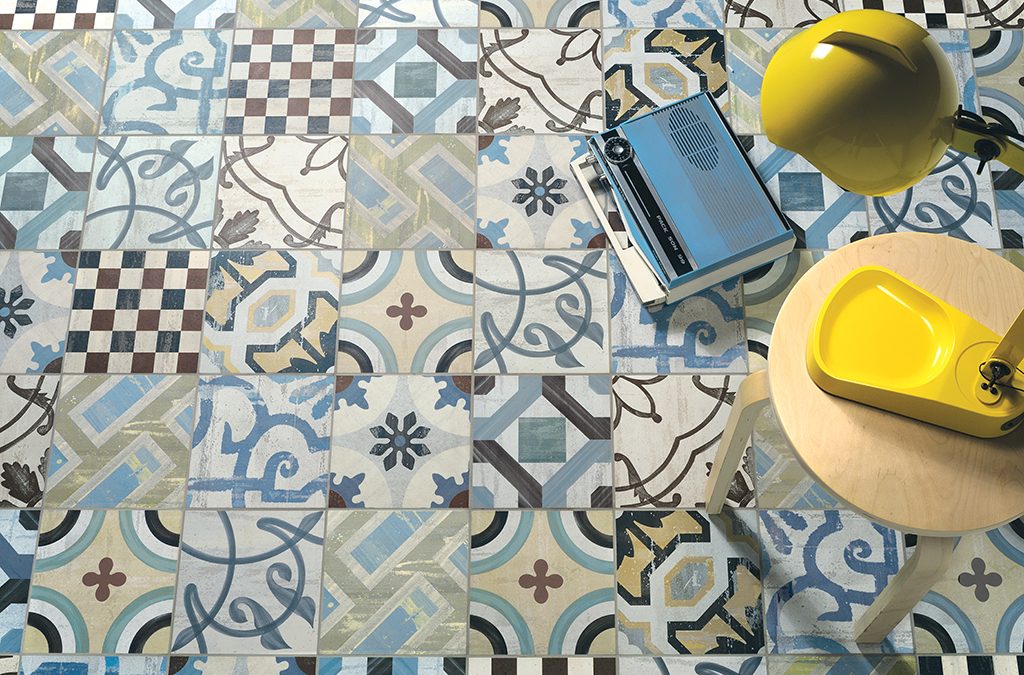
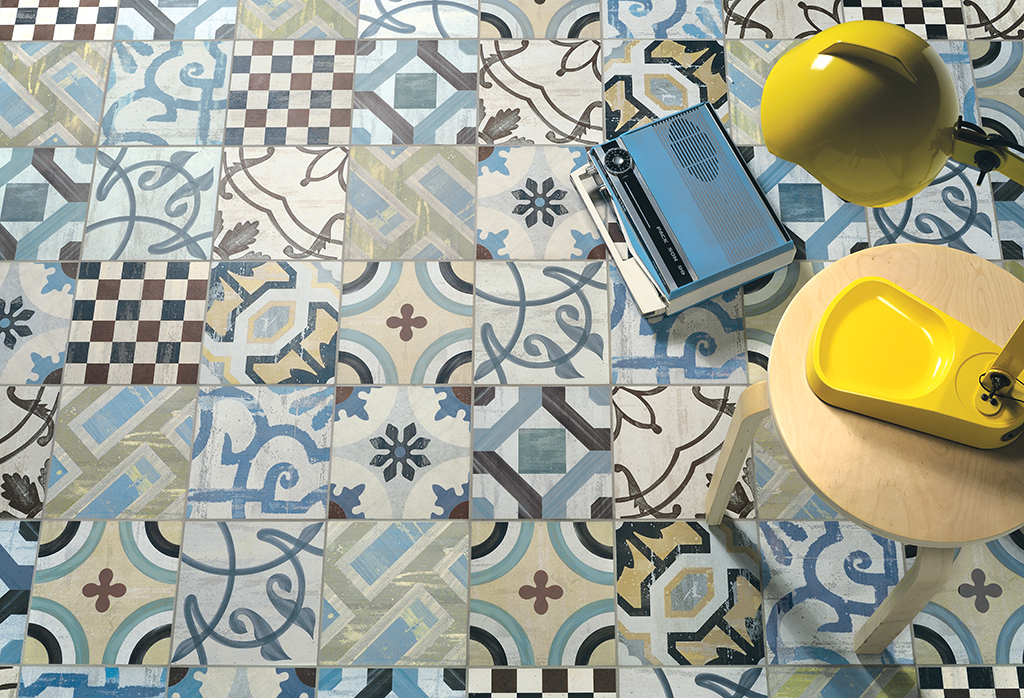
Encaustic-effect porcelain reproduces the patterns and palette of cement tiles on a porcelain stoneware tile fired at high temperature. The look is the familiar one; the behaviour is that of a technical material.
Absorption and stains
The key difference is water absorption. Porcelain absorbs ≤ 0.5 % of its weight: oil, wine or coffee stay on the surface and clean off with water and a neutral detergent. No sealing or waxing is needed. If you want to understand that figure on a data sheet, we explain it in how to read a tile data sheet. And if you are weighing glazed stoneware against porcelain, see stoneware vs porcelain tile.
Bathrooms, kitchens and patios
Where there is water, grease or direct sun, porcelain is the calm choice. In the bathroom, an encaustic-look porcelain floor can run into the shower, as long as the finish has the right slip resistance: we cover it in walk-in, level-access showers: which materials. In the kitchen it withstands stains that would stay in cement forever; you have the zone-by-zone criteria in kitchen tiles and flooring by area.
On patios and terraces, porcelain is not afraid of frost or salt air. Outdoors, ask for a slip-resistant finish, generally R11 or Class 3: the full explanation is in our guide to R9, R10, R11 and slip classes, and the outdoor criteria in outdoor porcelain paving in Mallorca.
Thickness and underfloor heating
A porcelain tile is considerably thinner than a cement tile. That helps in renovations where you do not want to raise the floor level much, and it works very well over underfloor heating, because it transmits heat quickly.
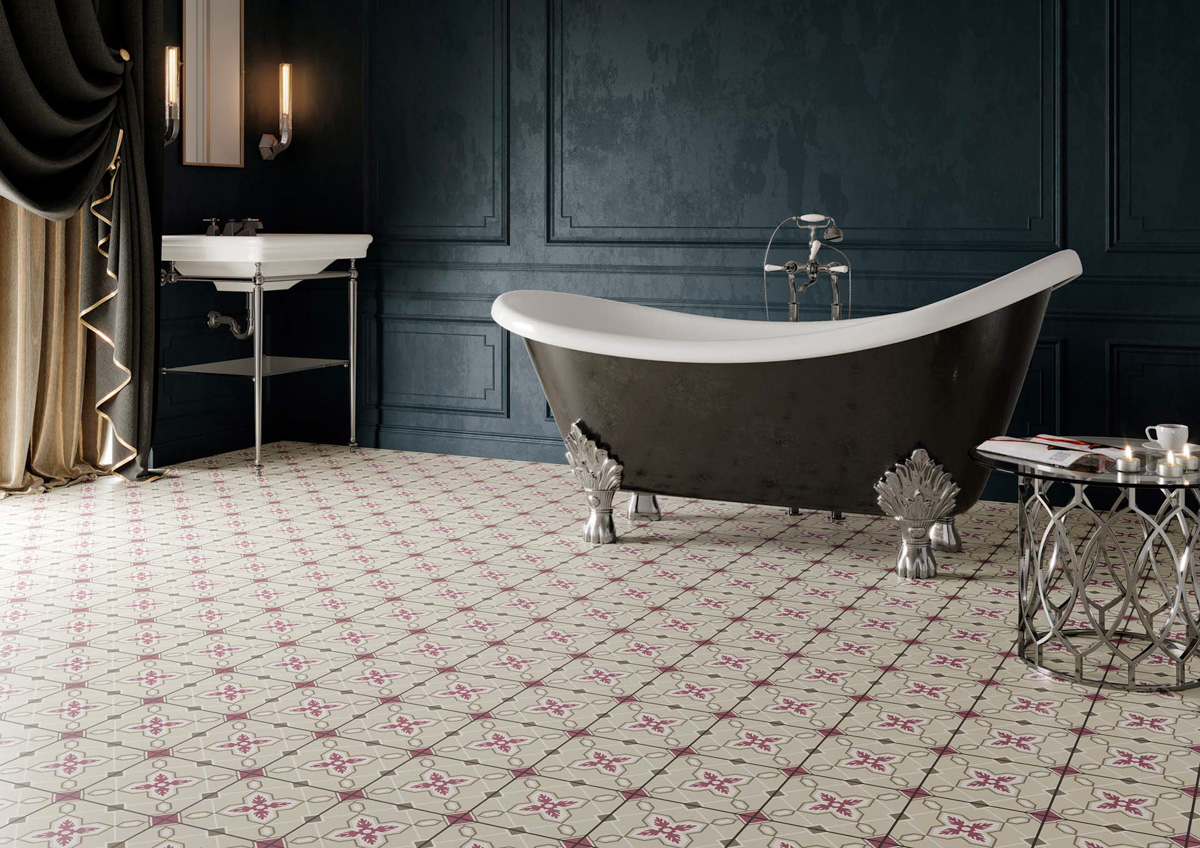
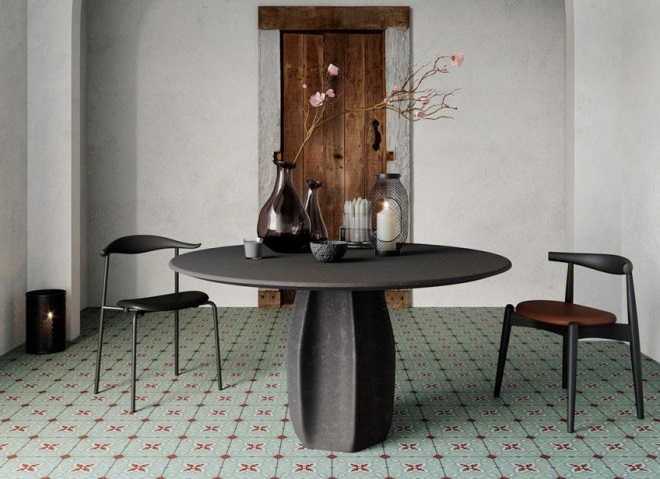
Original or porcelain: the comparison
| Encaustic cement tile | Encaustic-effect porcelain | |
|---|---|---|
| Material | Cement, marble dust and pigment, unfired | Porcelain stoneware fired at high temperature |
| Water absorption | High: needs sealing | ≤ 0.5 % |
| Maintenance | Periodic sealing and treatments | Water and neutral detergent |
| Bathroom and kitchen | Possible with great care | Yes |
| Outdoors | Delicate with frost and salt air | Yes, with a slip-resistant finish |
| Thickness | Around 2 cm | Thinner |
| Character | Patina, unique pieces, history | Consistent pattern, stable tones |
There is no absolute winner. Cement has a depth of colour and a touch that are lovely in a living room. Porcelain wins on everything to do with water, stains and heavy use.
Combining old and new
In many Palma renovations the best answer is a mix. The original floor stays in the living room or hall, where it is seen and walked on without water. The bathroom and kitchen are solved with an encaustic-inspired porcelain in a related tone, or with a plain tile that lets the old pattern breathe. The meeting point is marked by a threshold or a change of room, never halfway across a space.
If the house has a patio, the same reasoning works outwards: a porcelain that continues the interior tone links both spaces. We develop it in the same floor inside and out.
How to design an encaustic floor that does not tire
- A rug, not a sea. In large rooms, the pattern works better as a rug framed by a border or a plain tile than covering the whole surface.
- Two or three colours. Short palettes (black and white, earth tones, muted greens) age better than very busy ones.
- Mix with judgement. Several collections let you combine different decorated pieces in one floor, patchwork style. It works if they all share the palette.
- A fine joint in a close tone to the background colour, so the pattern reads as continuous.
- Quiet walls. With such a characterful floor, the wall asks for a plain finish, lime plaster or a single-tone handmade tile such as zellige.
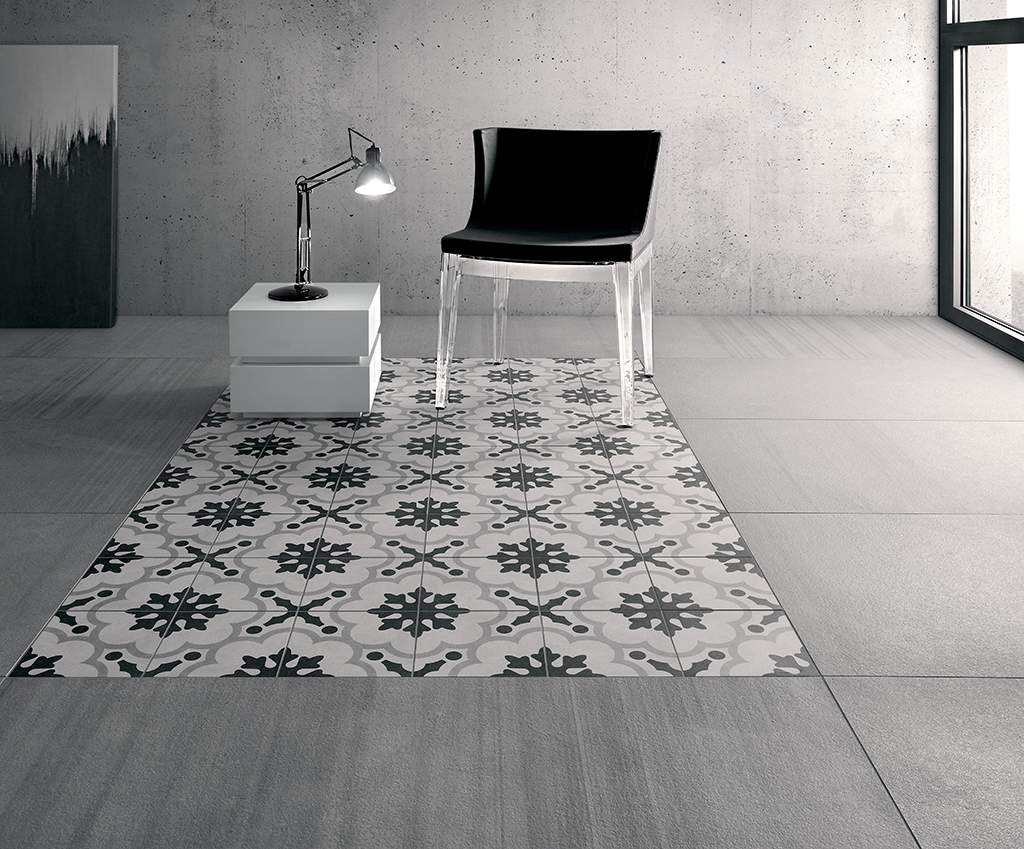
Encaustic-effect collections at Gomila Cerámica
These are the encaustic-inspired collections we work with. You can see them all in the showroom and in porcelain flooring.
- Fioranese · Cementine 20, which turns classic designs into contemporary patterns with modular solutions where colour is the key. And Cementine Black&White, a minimalist reading of encaustic tiles built on the balance between black and white.
- Apavisa · Hydraulic, which captures the beauty of encaustic tiles with the quality of porcelain stoneware, in a wide palette of colours and motifs, for interiors, patios and terraces, on floors and walls. And Senso, a vintage tile with a floral design of geometric figures, made for lovers of encaustic mosaic.
- WOW · on the wall, as a companion, Bejmat, a tribute to the handmade tile, with a tonal variation that sits well next to an encaustic floor.
If you are looking for a warm alternative to pattern, terracotta is the other great Mediterranean heritage: we tell its story in WOW’s terracotta.
Where to see it in Palma
An encaustic floor is best chosen with the tiles in your hand, seeing several joints and how the colour changes with the light. In our showroom you can see the encaustic-inspired collections and combine them with plain and wall tiles.
Gomila Cerámica
Carrer de Calçat, 16 · 07011 Palma (Mallorca)
Tel. +34 971 732 343 · info@gomila-ceramica.com
Opening hours and directions
Frequently asked questions
What is the difference between encaustic cement tiles and encaustic-effect porcelain?
Encaustic cement tiles are made of cement, marble dust and pigment, pressed and unfired, so they are porous and need sealing. Encaustic-effect porcelain reproduces the same pattern on fired porcelain stoneware, with water absorption of ≤ 0.5 % and minimal maintenance.
Is it worth restoring an old encaustic floor?
If most tiles are whole and well bedded, yes: a polishing specialist can bring back the colour and seal it, and broken tiles can be replaced. If many are missing, there is damp in the base or the renovation splits the floor between rooms, it is usually wiser to keep it only where it shines and solve the rest with porcelain.
Can encaustic tiles go in a bathroom or kitchen?
With cement tiles it is possible, but it requires periodic sealing and care with stains. With encaustic-effect porcelain there is no problem: it does not absorb liquids and cleans with water and neutral detergent. In the shower, choose a suitable slip-resistant finish.
Can encaustic-effect porcelain be used outdoors?
Yes, as long as the collection has an outdoor, slip-resistant finish, generally R11 or Class 3. Because it does not absorb water, it withstands frost and the salt air of the Mallorcan coast.
Can encaustic-effect porcelain go over underfloor heating?
Yes. It is thinner than cement tile and transmits heat well, so it is one of the most common choices over underfloor heating.
Where can I see encaustic-effect tiles in Palma?
In the Gomila Cerámica showroom at Carrer de Calçat, 16 in Palma, with encaustic-inspired collections from Fioranese and Apavisa that can be combined with plain and wall tiles.