In short
- A step has three parts worth naming correctly when you order: the tread (where you step), the riser (the vertical face) and the nosing (the front edge). At the sides, the stair skirting finishes the stair against the wall.
- Porcelain stair treads made as special pieces, with the edge already formed at the factory, give a cleaner and longer-lasting edge than a tile cut and mitred on site.
- The Spanish building code (CTE) asks a stair for one slip class more than the flat floor of the same space: Class 2 in dry indoor areas, Class 3 in wet indoor areas. Outdoors and around pools, always Class 3 (Rd > 45).
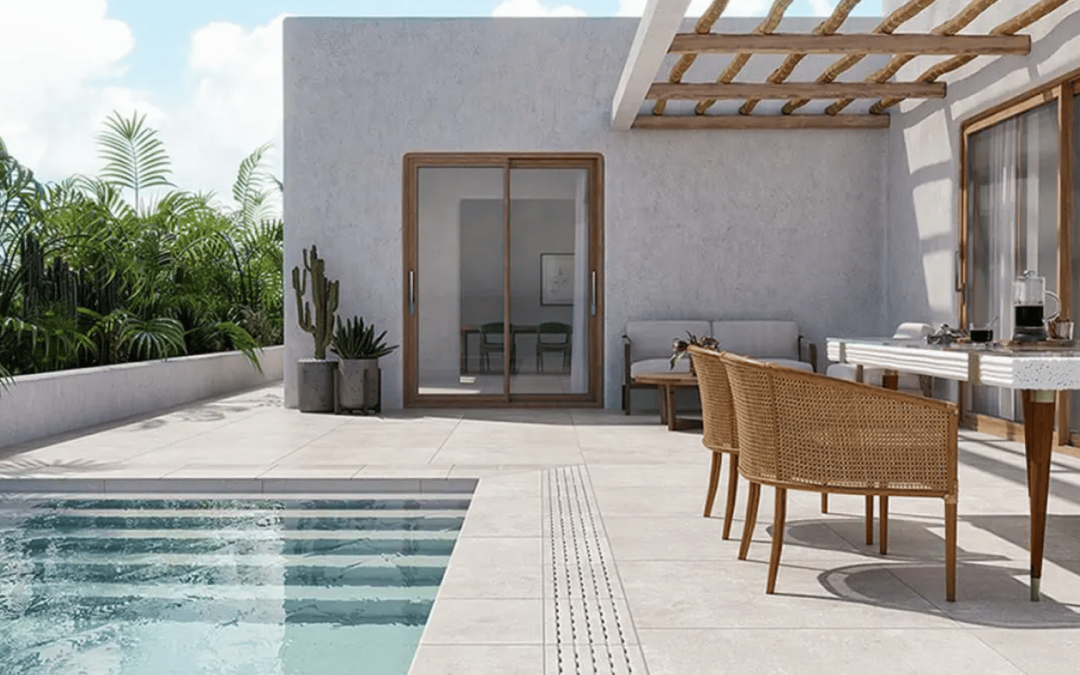
- Outdoors, 20 mm pieces and the anti-slip finishes of the same collection let terrace, stairs and pool read as a single floor.
- An edge you can see at a glance is safety, not decoration: in public spaces it is mandatory, at home it is good practice.
A staircase is looked at head-on and used edge-first. What you see as you walk into a house is the sequence of treads; what decides whether the stair is well resolved is the edge of each step, the exact point where the foot lands on the way down. That is why a porcelain staircase is not chosen only by the colour of the floor it continues: it is chosen by how it finishes, how it grips and how clearly one step stands apart from the next.
Anatomy of a step
Tread and riser
The tread is the horizontal surface you step on; the riser, the vertical face that separates it from the next one. Their dimensions are set by the design, not by the material, but they are worth knowing because they determine the format. The CTE (DB-SUA 1) requires, on stairs for general use, a minimum tread (going) of 28 cm and a riser between 13 and 18.5 cm, with the relationship 54 cm ≤ 2R + G ≤ 70 cm. Inside a private home, which the CTE treats as restricted use, the minimums are relaxed: a tread of at least 22 cm and a riser of no more than 20 cm.
Nosing
The nosing (mamperlán in Spanish) is the front edge of the step. It can be square, slightly rounded or project a little over the riser. It is the hardest-working part of the stair. A stair tread with nosing made in a single piece protects that edge; a cut tile leaves the arris exposed.
One regulatory nuance: on stairs for general use the CTE does not allow a projecting nosing, that is, an overhang of the edge beyond the riser that could catch the toe. At home there is more leeway, but the underlying principle is still useful.
Stair skirting
The stair skirting (or stringer skirting) is the skirting board of the stair: the stepped piece that follows the treads along the wall side. It protects the wall and makes the stair look finished. When the same series offers it, it is worth ordering together with the treads.
Special piece or tile cut on site
There are two ways to clad a staircase in porcelain.
With special pieces: factory-made treads, with the nosing already formed and the edge finished, plus a matching riser and skirting. The edge is continuous, the texture of the nosing matches that of the tread and the result ages without surprises.
With cut tiles: the floor tile is cut to the depth of the tread and the edge is resolved with a mitre (two pieces cut at 45°) or with a profile. This allows any collection to be used, even those without a step piece, but it demands a very precise hand: the mitre leaves a thin arris that, in a busy area or outdoors, is the first thing to chip.
The rule is simple: if the chosen collection has a step piece, use the step piece. If it does not, decide how the edge will be finished before buying the floor, not afterwards.

The stair as a continuation of the floor
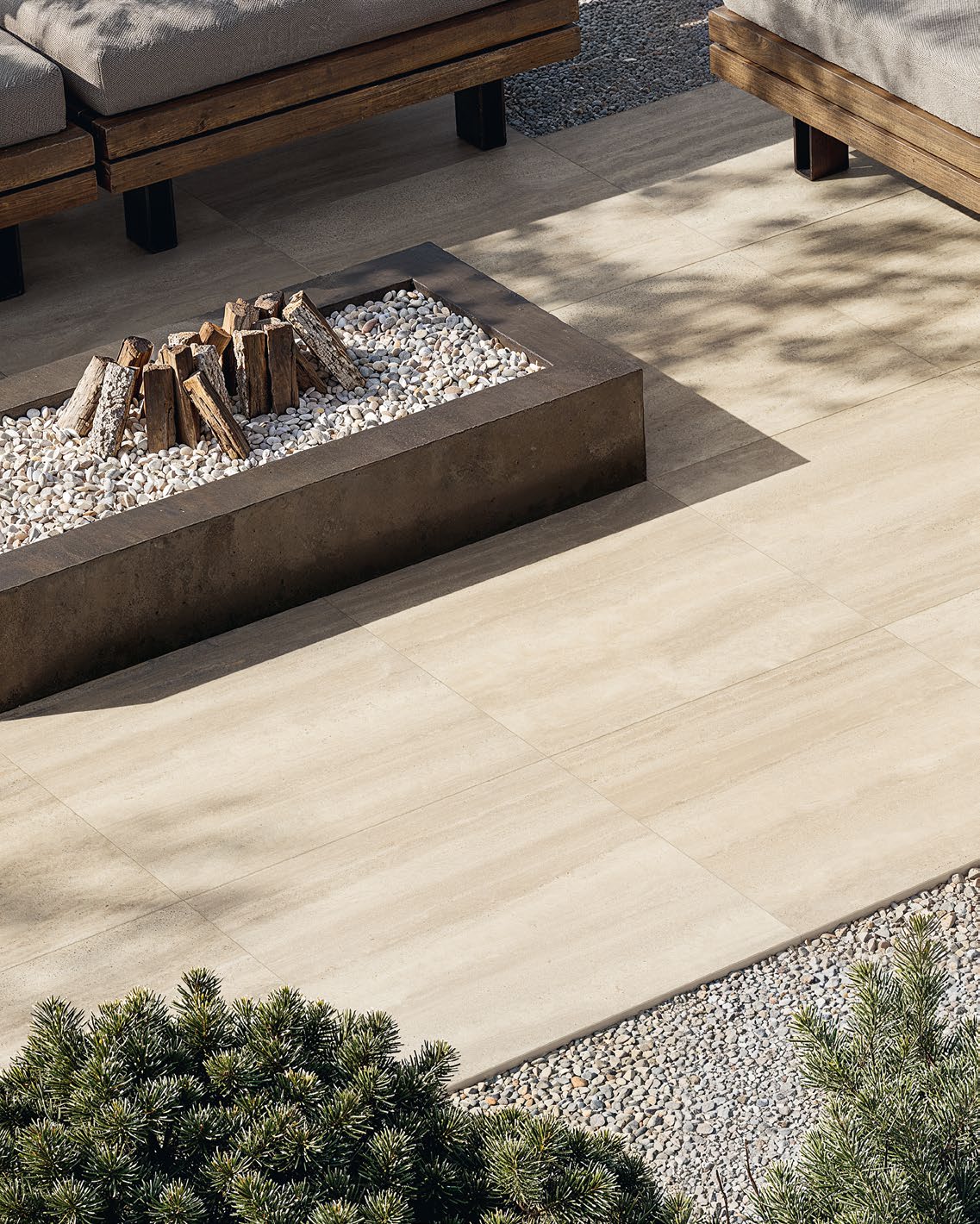
The calmest staircase is the one that does not interrupt the floor: same collection, same tone, same reading of grain or texture. That is why treads are ordered together with the floor, from the same batch, and not at the end of the project, when finding the exact tone is much harder.
If the floor has a grain, like a wood-effect porcelain, the direction is decided in advance: the natural choice is for the grain to run along the length of the tread, as a plank would. With a stone-effect porcelain the question is the variation between pieces: it is worth distributing it so that two consecutive steps do not repeat the same pattern.
If the indoor floor continues out onto the terrace, the outdoor stair follows the same logic as the paving: the same design inside and out, with the anti-slip finish of the same series on the outside.
Slip resistance: why stairs ask for more
On a stair the foot does not land fully or flat: going down, the front of the foot lands on the edge while the body is in motion. That is why the Spanish Technical Building Code requires stairs to have a higher slip class than the flat floor of the same space. Table 1.2 of DB-SUA 1 sums it up as follows:
| Location | Floor with slope < 6% | Slope ≥ 6% and stairs |
|---|---|---|
| Dry indoor areas | Class 1 | Class 2 |
| Wet indoor areas (entrances from outside, covered terraces, bathrooms, kitchens) | Class 2 | Class 3 |
| Outdoor areas, pools (barefoot areas and pool basin up to 1.50 m deep) and showers | Class 3 | |
The class is obtained with the pendulum test: Class 1 is 15 < Rd ≤ 35; Class 2, 35 < Rd ≤ 45; Class 3, Rd > 45. Many data sheets also give the R value (R9, R10, R11…) from the ramp test; these are different scales and do not map one to one. We explain it in detail in our guide to R9, R10, R11 and slip class.
An honest clarification: this CTE requirement applies to buildings for public residential, healthcare, educational, commercial, administrative and public assembly use. In a private home it is not mandatory, but it is the best criterion available, and it is the one we follow when we make a recommendation.
Indoor stairs
For a dry indoor stair, Class 2. If the stair starts next to the front door or the terrace door, where water comes in on people’s shoes, it is wise to treat it as a wet area and go up to Class 3. Polished or lappato finishes, lovely in a living room, are not a good choice for the tread.
Outdoor stairs
An anti-slip outdoor stair requires Class 3, without exception. In Mallorca you have to allow for the autumn rain, which arrives all at once. A structured finish takes care of grip; an excessively rough one holds dirt and is harder to clean. Which paving to choose outdoors, and why, is covered in outdoor porcelain paving in Mallorca.
Pool steps
The steps into the pool and the steps on the pool surround are walked on barefoot and wet: Class 3. The full criteria for the water zone are in anti-slip flooring for pools.
The edge you can see
Most trips on a stair are not slips: they are misjudged steps, because the eye cannot tell where one step ends.
In urbanised public spaces, Spanish accessibility regulation (Orden TMA/851/2021, art. 15) requires each step to be marked along its full length with a 5 cm strip, flush with the tread and set 3 cm from the edge, contrasting in texture and colour with the rest of the step. At home it is not mandatory, but the idea is useful: a nosing in a slightly different tone, an edge with another texture or a low light in the riser or the skirting makes the stair legible without breaking the continuity of the floor.
Outdoors: thickness and format
Outdoors, 20 mm porcelain is very common for terrace and garden paving, and several outdoor collections pair it with special pieces in the same thickness. For a stair it has an obvious advantage: a thicker edge that stands up better to knocks.
The format is set by the tread: first measure the stair, then look for the piece that resolves it with the fewest cuts; on wide stairs, with long pieces or with several pieces in a row per step. If the floor is large format, check beforehand that the collection has a step piece or that cutting allows a well-resolved edge.
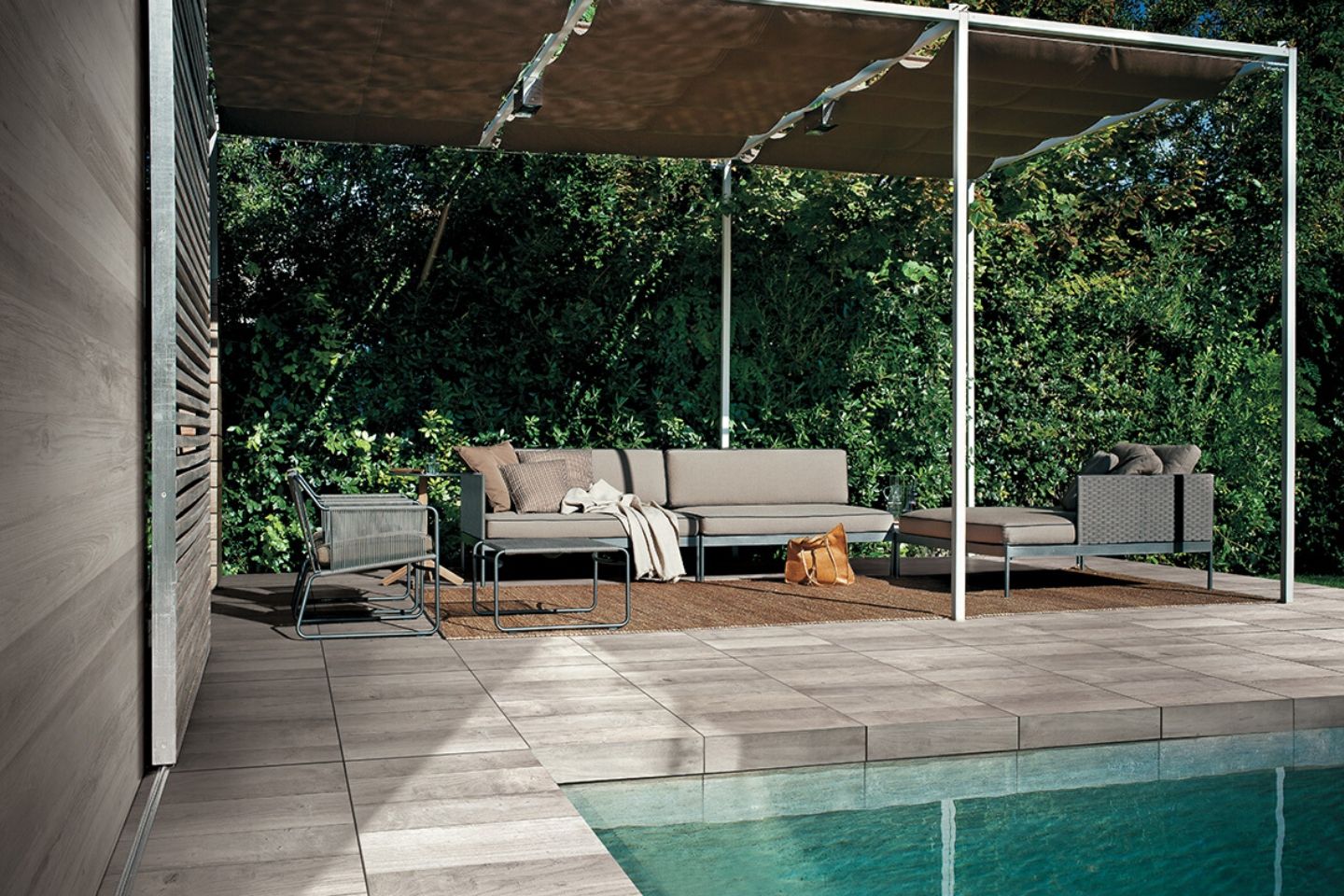
Collections with stair treads and special pieces
These are the lines in our porcelain flooring catalogue that work best for a staircase:
- Cerámica Mayor: a long tradition in flooring and special pieces in extruded material. Its Crosscut collection, inspired by travertine, offers a range of formats, stair treads and pool pieces to keep the same look inside and out.
- Kronos: a selection of ceramic cements, stones and woods dedicated specifically to outdoor use, with 2 cm thickness and special pieces. Its Les Bois collection, in a wood effect, is suitable for indoors and outdoors.
- Rosa Gres: in the Mistery collection, the Blue Stone colour combines an anti-slip finish with a range of special pieces in the same colour to coordinate the whole exterior of the house.
- Ragno: Realstone Argent and Stratford feature StepWise anti-slip technology, for indoors and outdoors.
- Coem: the Sinai collection, a stone effect, in the R11 Soft & Safe anti-slip finish suitable for outdoor areas and pools, with 20 mm pieces for outdoor use.
The availability of tread, riser and skirting pieces varies with the format and finish of each series: we confirm it with you, collection by collection, before the order is placed.

What to have decided before you order
- Actual dimensions of tread, riser and width of each flight, and the number of steps, including those at landings.
- Type of edge: tread with factory-formed nosing, mitre or profile.
- Slip class according to where the stair is: dry indoor, wet indoor, outdoor or pool.
- Complementary pieces: riser, stair skirting, landing skirting and, at a pool, coping.
- Same batch for floor and treads, with a reserve margin for cuts and replacements.
- How the edge will read: contrast of tone, texture or light.
The general laying criteria are in our guide to laying porcelain flooring.
Where to see it in Palma
A stair tread needs to be held in the hand: look at the edge, run a finger along the nosing, compare the texture of the tread with that of the floor. At our showroom you can see the special pieces alongside the floor collections, and bring the measurements of your stair to go over them calmly.
Gomila Cerámica
Carrer de Calçat, 16 · 07011 Palma (Mallorca)
Tel. 971 732 343 · info@gomila-ceramica.com
Opening hours and how to find us
Frequently asked questions
What is a stair tread with nosing?
It is a step piece with the front edge already formed at the factory, square or slightly rounded. It protects the arris, which is the part of the stair that takes the most wear, and avoids having to mitre the edge or fit a profile on site.
What slip class does an outdoor stair need?
Class 3 under the Spanish building code, CTE (Rd > 45). DB-SUA requires Class 3 in all outdoor areas and pools, whether flat or stepped.
And an indoor stair?
Class 2 if it is a dry indoor area. If it is in a wet area, such as an entrance from outside or a covered terrace, Class 3. Indoors, a stair always asks for one class more than the flat floor of the same space.
Can I use the same porcelain on the stairs as on the floor?
Yes, and it is the best way to keep continuity. Ideally, use the step pieces from the same collection; if there are none, the tile is cut and the edge is resolved with a mitre or a profile. Outdoors, use the anti-slip finish of the same series.
Do I need 20 mm porcelain for an outdoor stair?
It is not mandatory, but it is very common outdoors: the edge is thicker and stands up better to knocks, and it allows the stair to continue a 20 mm terrace without changing pieces.
Do stair edges need to be marked?
In public spaces, yes: Orden TMA/851/2021 requires a 5 cm strip set 3 cm from the edge, contrasting in colour and texture. In a private home it is not mandatory, but an edge you can see at a glance reduces trips.