In short
- Glass mosaic adapts to curves, steps and tight radii; it is the most versatile option for the inside of the pool shell.
- Porcelain has fewer grout lines and larger formats; it suits straight-sided pools and lets the same floor continue out onto the terrace.
- For permanent immersion, the tile must declare a water absorption of ≤ 0.5 % (group BIa of standard EN 14411).
- Around the pool what matters is slip resistance: R11 and Class 3 are the usual reference for barefoot, wet areas.
- Neither material makes up for a poorly waterproofed shell: adhesive and grout must be rated for permanent immersion and for chlorinated or salt-treated water.
There are two ways to tile a pool in Mallorca, and both are right. The question is not which material is better, but what you are asking of your pool: whether it has curves or straight lines, whether you want the water to read deep blue or sand, whether the terrace floor should continue inside or stop at the edge.
This guide compares glass mosaic and porcelain against checkable criteria, so you reach the decision with the questions already answered.
What each material is
Glass mosaic
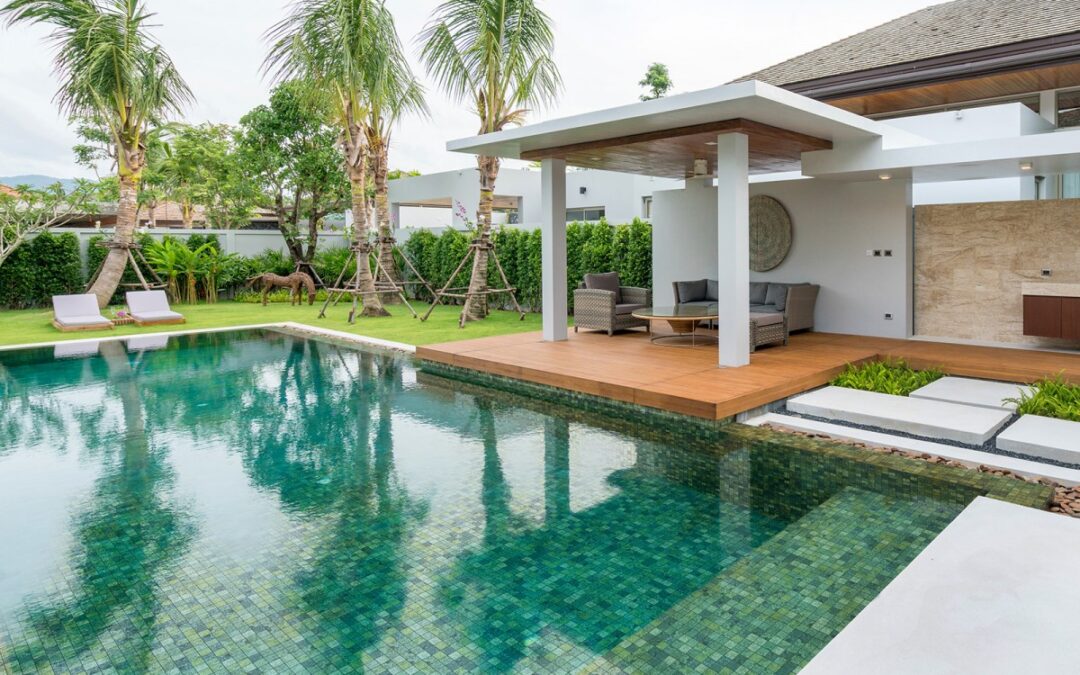
Glass mosaic comes in small tesserae — usually 2.5 cm a side — held together on mesh or paper-faced sheets so they can be laid in panels. Because the pieces are small, the sheet folds: it climbs a Roman step, turns a tight radius and resolves an organic shape without forced cuts.
Glass does not absorb water. That is its starting advantage in a shell that stays full all year. In exchange, it multiplies the grout surface, and the grout becomes the critical part of the assembly.
At Ezarri we work with mosaic made from recycled glass, with collections such as 50mm — tesserae four times larger than the usual 25 mm — Aquarelle, with soft anti-slip textures, and Gemma, with a gloss finish and distinctive veining. At Onix and Mosaico+ you will find other mosaic families for water and wet areas.
Porcelain
Porcelain is a ceramic tile pressed and fired at high temperature until the body is very dense. For pools you want the kind that declares a water absorption of 0.5 % or less and is expressly rated for permanent immersion: not all porcelain is.
Its logic is the opposite of mosaic: few pieces, few joints, continuous surfaces. In a rectangular shell the result is clean and quiet, and it lets you carry the same material — or its outdoor version — out to the beach area and the terrace.
At Rosa Gres you will find collections made for pools and terraces, such as Trésor — Bali, in turquoise tones, and Java, volcanic — or Mistery, whose Blue Stone is described as «perfect for terraces thanks to its resistance and excellent anti-slip finish». Also Sophy, with anti-slip, low-maintenance surfaces, plus Cuore and Coral in a light Mediterranean range.
Head to head
| Glass mosaic | Porcelain | |
|---|---|---|
| Format | 2.5 cm tesserae; also 5 cm | Medium up to large format |
| Water absorption | None: glass does not absorb | ≤ 0.5 % in immersion-rated tiles |
| Curves and steps | Adapts without forced cuts | Needs trim pieces and cuts |
| Grout lines | Many: they define the result | Few: a more continuous surface |
| Continuity with the terrace | Material changes at the coping | Same floor inside and out |
| Water colour | Gradients and blended tesserae | Even, stable tone |
| Substrate demands | High | Very high in large format |
| Upkeep | Keep an eye on the grout | Easy cleaning, less grout |
Zone by zone: where each one fits
The decision is rarely «all mosaic» or «all porcelain». Combining them is the norm:
- Inside the shell, with curves or a Roman step. Glass mosaic. This is where its ability to fold makes the difference.
- Inside the shell, rectangular. Either. Immersion-rated porcelain gives a more continuous finish; mosaic gives more depth of colour.
- Coping and edge. Specific trim pieces, with a rounded nose and an anti-slip finish.
- Beach area and terrace. Anti-slip outdoor porcelain. Mosaic does not compete here: you want broad surfaces, easy cleaning and comfort underfoot.
- Steps and level changes. They should be legible. A change of tone or texture helps more than any signage.
If you like the idea of the terrace floor continuing indoors, we cover it in our guide to the same floor inside and out.
The three things that actually decide it
Water absorption
This is the figure that separates a suitable tile from an unsuitable one. It appears on the data sheet as water absorption and must be 0.5 % or less for permanent immersion. The glass in mosaic does not absorb, so the question only applies to porcelain. Learning to read that figure — and the rest — is more useful than it sounds: we explain it in how to read a tile data sheet.
Slip resistance
Inside the shell it matters less; around it, it comes first. In barefoot, wet areas the usual reference is R11 and Class 3. It is a declared value, not an impression: if it is not on the data sheet, do not assume it. We have a dedicated guide to which anti-slip class a pool needs.
The grout
This is where the service life of the finish is decided, and where the budget is most often underestimated. Grout and adhesive must be rated for permanent immersion and compatible with the water treatment — chlorine or salt chlorination. Excellent mosaic with the wrong grout ages badly; perfect porcelain over a shell that moves does too.
We sell and advise on the material; the installation is your fitter’s job. What we can give you is everything they need to know in order to specify the right system: you can pass on our guide to laying porcelain floor tiles.
The water colour changes with the finish
This is the part that surprises people most. Water has no colour: it reflects the shell. A white finish gives a very pale, almost crystalline blue; sand gives green-turquoise tones; grey or black give depth and the look of a still sheet of water.
It is worth settling the colour before the material, because it shapes the choice more than you would expect. We go into it in what colour your pool water will look, and in the specific case of Trésor Bali by Rosa Gres.
What you will find at Gomila
In our Palma showroom you can see and handle both families before deciding: glass mosaic from Ezarri, Onix and Mosaico+, and pool and outdoor porcelain from Rosa Gres, among other brands in our porcelain flooring and mosaic catalogue.
We work with private clients and with professionals across Mallorca, advising on formats, finishes, trim pieces and material compatibility. If you already have the shell measurements or the project drawings, get in touch and we will go through it with you.
Frequently asked questions
Which is better for a pool, glass mosaic or porcelain?
It depends on the geometry. For shells with curves, a Roman step or organic shapes, glass mosaic adapts better. For rectangular shells and continuous finishes, immersion-rated porcelain gives a cleaner result and lets the same floor continue onto the terrace. Combining the two — mosaic inside, porcelain outside — is very common.
Can I use ordinary porcelain in a pool?
No. Only porcelain with a water absorption of 0.5 % or less and expressly rated by the manufacturer for permanent immersion. Indoor porcelain is not designed to sit submerged continuously or to withstand chlorine or salt chlorination.
What slip resistance does a pool edge need?
In barefoot, wet areas the usual reference is R11 and Class 3. It is a value declared on the product data sheet and worth checking before you choose, especially for the beach area, coping and steps.
Does glass mosaic need more maintenance than porcelain?
It has more grout surface, so the grout is the thing to watch. With a grout rated for permanent immersion and compatible with the water treatment, maintenance is perfectly reasonable. Porcelain, with fewer joints, makes cleaning simpler.
Can I use the same material in the shell and on the terrace?
You can use the same collection in different finishes: the immersion-rated one inside the shell and the anti-slip outdoor version on the beach area. That is the usual way to get visual continuity without giving up grip.
Where can I buy pool mosaic and porcelain in Mallorca?
At Gomila Cerámica in Palma de Mallorca. We have a showroom with glass mosaic and with pool and outdoor porcelain, and we advise on formats, finishes and trim pieces for private clients and professionals across the island.