In short: a well tiled bathroom or kitchen depends more on the preparation than on the tile itself. The wall has to be flat, dry and sound; the adhesive has to suit the tile size; grout joints and the tile layout are decided before the first row goes up, and corner trims are bought together with the tiles. In Mallorca it also pays to think about humidity, salt air and hard water: porcelain wall tiles, with very low water absorption, are the most worry-free choice.
Wall tiling and floor tiling: what changes
Tiling a wall means covering it with ceramic or porcelain tiles; tiling a floor is the same job on the ground. The difference looks small but changes almost everything: on a wall the tile hangs, with no weight on top to hold it, so the adhesive bond, the flatness of the substrate and the size of the tile matter even more.
If you are also replacing the floor, everything you need is in our practical guide to laying porcelain floor tiles. Here we focus on bathroom and kitchen walls, the surfaces that get tiled most in a renovation.
Choosing the wall tile
Porcelain or white-body ceramic
Two kinds of tile are mostly used on walls. White-body ceramic (the classic wall tile) is light, easy to cut and very decorative, but it absorbs more water. Porcelain absorbs 0.5 % of water at most, stands up better to knocks and stains, and is the one we recommend for showers and kitchen splashbacks. To compare data sheets, see how to read a tile data sheet, where we explain water absorption, PEI and rectified edges.
Size: small, medium or large format
The tile size sets the character of the wall and also how demanding the job is:
- Small tiles (from 5×15 to 15×15 cm): texture, craft and play of light. They adapt well to walls that are not perfect and to corners with many cuts. More joints, more upkeep.
- Medium and elongated tiles (from 30×90 to 40×120 cm): the usual balance in today’s bathrooms. Fewer joints, but they need a properly flat wall.
- Large format (60×180 cm and up): an almost continuous wall with no visible cuts. It needs a very flat substrate, two people to handle each piece and an experienced tiler. More in large format tiles: sizes, benefits and uses.
In a small bathroom, large light-coloured tiles make the room feel bigger; there are more ideas in tiles for a small bathroom.
Relief, gloss and handmade-look tiles
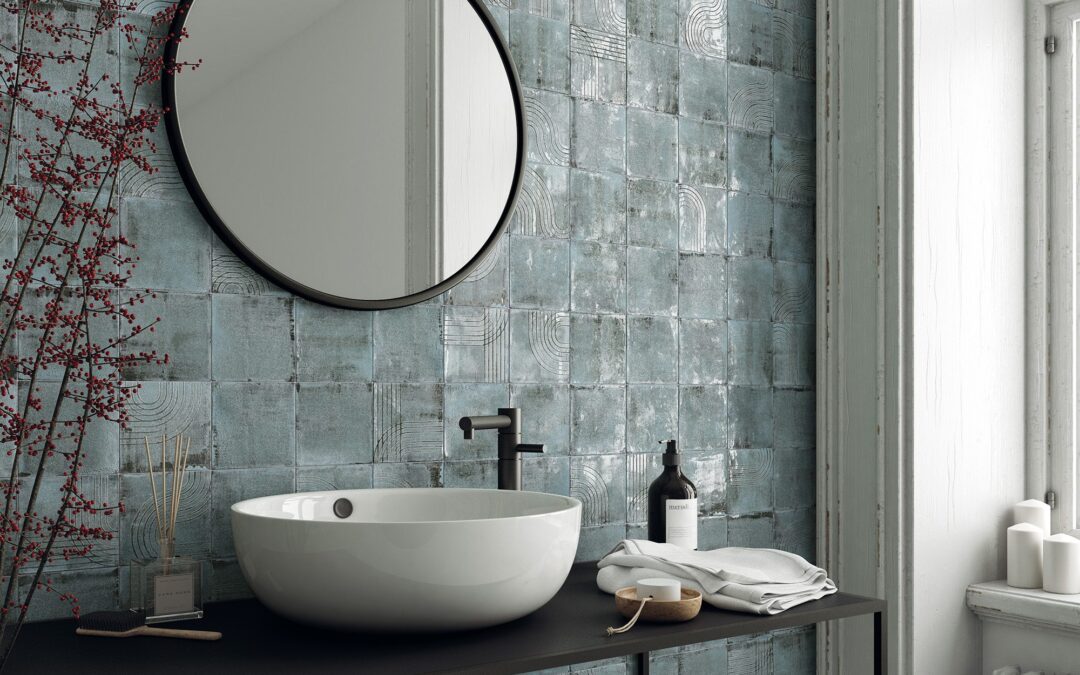
Tiles with relief or an irregular surface, such as zellige or its porcelain versions, are laid differently: each tile has its own thickness and its own shade, and the charm lies in not trying to make them look the same. Ask your tiler to mix tiles from several boxes as they go. We explain how they are handled in what is zellige.
What to ask your tiler before work starts
In Spain, laying ceramic tiles with adhesive has its own standard, UNE 138002 (revised in 2023). You do not need to know it, but your tiler should work to it. These are the four conversations worth having before the first row goes up.
The wall: flat, dry and sound
A tile copies the wall behind it. If the wall bulges, the tiles will end up with lips at the edges; if it is damp, the adhesive will not bond properly. Before tiling, the wall must be flat (plastered or levelled), dry and sound, with no paint or loose material. If you tile over old tiles, check that they are firmly bonded by tapping them: if they sound hollow, they have to come off.
The right adhesive for the tile size
Porcelain barely absorbs water, so it does not bond well with traditional cement mortar: it needs an improved cementitious adhesive (type C2), and for large tiles or exterior walls, a deformable one (marked S1 or S2 on the bag). With large formats, adhesive manufacturers also call for back-buttering: adhesive on the wall and on the back of the tile as well. The Mapei adhesives on our construction materials page state on their data sheets which tile sizes and substrates they are for.
Grout joints and layout
No tile is laid with zero joints. Even rectified tiles need a minimum joint to absorb the small movements of the wall. The layout (where the first tile starts and where the cuts fall) is decided beforehand: ideally the cuts end up in the least visible corners, not in the middle of the wall you see as you walk in. On walls with a niche, window or mirror, it is worth drawing it out.
Trims, corners and junctions
Outside corners, the edge of a niche or the junction with the shower tray are finished with trim profiles (aluminium or stainless steel, such as those by Schlüter-Systems) or with tiles mitred at 45 degrees. It is a small detail that changes the finish a great deal, and it is best bought together with the tiles so that colour and thickness match.
Not sure which material?
Call us and we’ll help you choose in no time, with no obligation.
Areas that need extra care
The shower
The shower wall gets the most water. Behind the tiles there has to be waterproofing (a membrane or liquid membrane, especially in the corners and where the wall meets the floor), and the joints in that area benefit from a good quality grout. If you also want a level, tray-free floor, we explain it in walk-in and level-access showers: which materials to choose.
The kitchen splashback
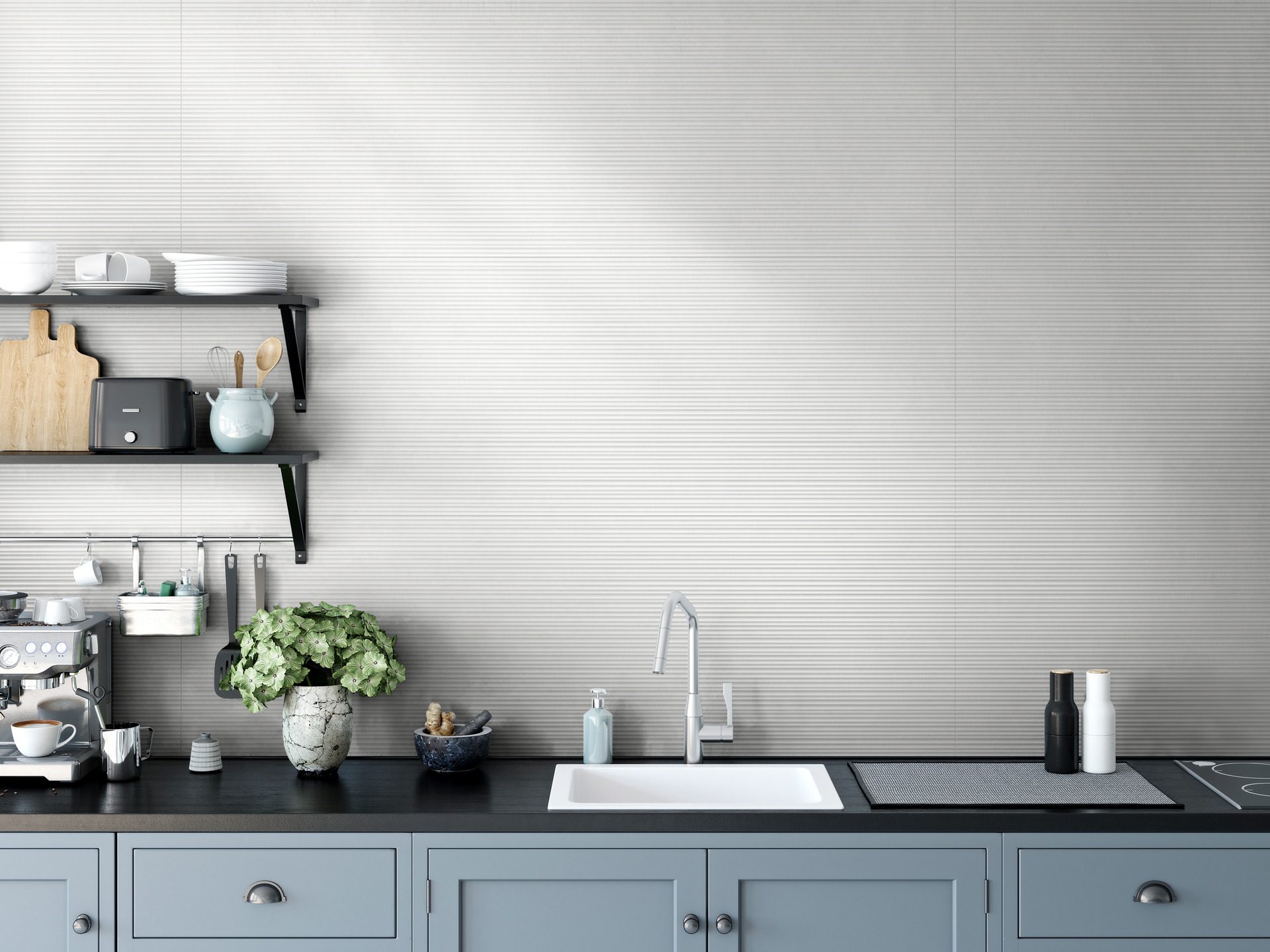
Between the worktop and the wall units, the tiles take splashes, grease and heat. Non-porous, easy-to-clean tiles and fine joints work well here. A large format tile, or the worktop material itself running up the wall, removes almost every joint. There are ideas in ceramic kitchen splashbacks and, to coordinate it with the floor, in kitchen tiles and flooring by area.
Tiling in Mallorca: humidity, salt air and hard water
A house in Mallorca, especially near the sea, comes with three conditions worth keeping in mind when tiling:
- Humidity: in poorly ventilated bathrooms and in old houses with stone walls, the wall has to be completely dry before work starts. If there is rising damp, it is solved first with the project’s technician, not with the tile.
- Salt air: on terraces, porches and exterior walls, porcelain and a deformable adhesive cope better with cycles of sun, salt and temperature.
- Hard water: the island’s water leaves white marks on the shower screen and in the shower grout. Smooth, non-porous surfaces are much easier to clean; more in how to clean porcelain tiles with hard water.
Five costly mistakes
- Tiling over a crooked wall. The most common mistake. Fixing the wall first costs less than lifting the tiles afterwards.
- Using the wrong adhesive. Basic tile cement is not suitable for large format porcelain.
- Buying exactly the amount needed. With no margin for cuts and breakage, the missing tile may come from another batch and another shade.
- Forgetting the trims. Corners solved at the last minute are usually the ones that look worst.
- Deciding the layout on the go. A two-centimetre cut in the middle of the main wall cannot be fixed later.
How much tile to order
Measure each wall (width by height), add up the square metres and subtract doors and large windows. To that figure add a margin for cuts and breakage: around 10 % for straight laying and a little more for small tiles, herringbone layouts or walls with many openings. Order everything from the same batch and keep a spare box for future repairs. For an idea of the total cost of the work, it is broken down by item in how much does a bathroom renovation cost.
Wall tile collections at Gomila Cerámica
In our Palma showroom we have collections designed for walls, in every size:
- Stratford Wall by Ragno: 40×120 cm with selective relief, in white, grey, clay, red and blue. For bathrooms with character that keep their calm. See Ragno.
- Papers by Ragno: a wallpaper effect in 60×180 cm, for a feature wall in the bathroom or dining room. More in ceramic wallpaper.
- Gleeze and Glacé by Ragno: small glossy and handmade-look tiles, for showers and kitchen splashbacks with texture.
- Bejmat by WOW: zellige-inspired porcelain, 15 colours in 5×15 and 15×15 cm. See WOW.
- ENSO and ICON by WOW: geometry and relief in modular pieces, to play with grazing light.
- Reverso by Coem: large format for walls with almost no joints. See Coem.
- Onix and Ezarri mosaics: for niches, showers and curved areas. See mosaics.
And to get the installation right, our construction materials page has Schlüter-Systems trim profiles and Mapei adhesives. You can browse all our porcelain in the porcelain section or write to us with your bathroom measurements: we will help you choose the tile, work out quantities and prepare the list for your tiler.
Frequently asked questions
What is the difference between wall tiling and floor tiling?
Wall tiling covers walls with ceramic or porcelain tiles; floor tiling covers the floor. On a wall the tile hangs, so the adhesive, the flatness of the substrate and the size of the tile matter even more.
Which tile is best for a bathroom wall?
For wet areas, porcelain, because it absorbs 0.5 % of water at most and resists stains and limescale well. White-body ceramic is a good decorative option on walls that get less water.
Can you tile over old tiles?
Yes, if the old tiles are firmly bonded and the wall is flat. Tap the tiles: if any sound hollow, that area should be removed. You also need an adhesive suitable for non-porous surfaces.
Which adhesive is used for porcelain wall tiles?
An improved cementitious adhesive, type C2, and for large tiles or exterior walls a deformable one (S1 or S2). With large formats, back-buttering is recommended: adhesive on the wall and on the back of the tile.
How much extra tile should I buy?
Around 10 % more than the measured area for straight laying, and a little more for small tiles or complex layouts. All from the same batch, plus a spare box for repairs.
Where can I see wall tiles for a bathroom in Palma?
At the Gomila Cerámica showroom, Carrer de Calçat 16, Palma, with wall collections in every size, mosaics, trim profiles and installation adhesives.
Can we help with your project?
We’ll advise you with no obligation, by phone, by email or at our showroom in Palma.