In short
- When renovating a finca in Mallorca, the first decision is not the finish: it is checking damp in walls and slabs, the floor levels and whether there will be underfloor heating.
- The language of the Mallorcan country house rests on four materials: terracotta, stone, encaustic tile and wood. All four now exist in porcelain, with water absorption of ≤ 0.5 % and no regular sealing.
- The same floor can run from the living room to the porch and down to the pool if the collection has a non-slip outdoor version (R11) or a 20 mm slab.
- If the house keeps original floors in good condition, it is worth keeping them where they shine and solving wet areas and outdoor spaces with porcelain. You can see the collections in our showroom in Palma, Carrer de Calçat 16.
A finca is not renovated like a flat. The walls are thick, the floors have a history and the house opens to the countryside on every side: the porch, the courtyard, the terrace, sometimes a pool. Choosing floors and wall tiles well is what lets the renovation respect that character while keeping the house comfortable and easy to look after all year round.
In this guide we order the decisions the way they usually come up on site: first what the building needs, then the language of the materials and, finally, room by room.
Before choosing: what an old house needs
Damp in walls and slabs
Many Mallorcan country houses were built with stone walls and uninsulated floor slabs. Rising damp from the ground is common. Before talking about finishes, the project’s technician should assess whether a new slab, a damp-proof membrane or a ventilated void is needed. No floor, however good, solves damp at its source.
Once that is sorted, porcelain is an ally: it barely absorbs water (≤ 0.5 % of its weight) and does not swell or warp. To understand that figure on a data sheet, see how to read a tile data sheet.
Levels, thicknesses and underfloor heating
In a full renovation the levels often change: doors that cannot be trimmed, stone thresholds you want to keep, steps between rooms. It is worth deciding the floor thickness early. Porcelain of 10 mm or less saves millimetres; 20 mm slabs are reserved for outdoors, where they can sit on gravel or pedestals.
If underfloor heating is going in, one of the most pleasant ways to heat a house with thick walls, porcelain conducts heat well and does not move with changes in temperature.
The language of the finca: four materials with a history
The Mallorcan country house has a recognisable palette: fired clay, golden stone, painted cement rugs and wooden beams. The good news is that this language can now be kept with technical materials, and combined without the house looking like a catalogue.

Terracotta
Fired clay is the floor of many fincas: warm, matt, with shade variations from one tile to the next. Its weak point is porosity, which means it needs treating and makes it delicate in kitchens and outdoors. The Roots collection by WOW brings that character to porcelain, with a soft-touch finish and slip resistance that allow it to be used indoors and out. We present it in detail in WOW’s terracotta inspired by nature.
Mallorcan stone
Stone is the material of walls, thresholds and courtyards. Amara by Inalco is inspired by Binissalem stone: a cream MDi with soft relief in large format, in 6, 10 and 12 mm, to solve wall, floor and worktop with the same material. More in Amara by Inalco, the porcelain that echoes Mallorcan stone. For a stone with more patina, Abbey Stone by WOW recreates aged stone with an R11 non-slip finish. More options in stone-effect porcelain.
Encaustic tile
Many fincas renovated in the early twentieth century still have encaustic cement floors. If they are complete, restoring them is worthwhile. If tiles are missing or the renovation takes the pattern into a bathroom or kitchen, encaustic-effect porcelain such as Cementine 20 by Fioranese gives the same pattern with no sealing. The full comparison is in encaustic cement tiles in Mallorca: original or porcelain.
Wood
In bedrooms or under the roof, wood brings warmth. In a finca, with damp in winter and strong sun in summer, wood-effect porcelain is the stress-free alternative. Les Bois by Kronos offers five wood tones, long planks, 10 and 20 mm thicknesses and an outdoor line. We compare both materials in wood-effect porcelain or parquet.


Room by room
| Room | What it needs | Options that suit a finca |
|---|---|---|
| Entrance and living room | Foot traffic, soil from the garden, warmth | Terracotta in porcelain (Roots), stone (Amara, Abbey Stone) or the restored original encaustic floor |
| Kitchen | Stains, grease, daily cleaning | Porcelain on the floor; a 12 mm porcelain worktop (Amara) to match |
| Bathrooms | Water, level-access shower | Porcelain with a non-slip finish in the shower; encaustic-effect porcelain as an accent |
| Bedrooms | Comfort, underfloor heating | Wood-effect porcelain (Les Bois) or terracotta in soft tones |
| Porch, courtyard and terrace | Sun, rain, salt air, slip resistance | R11 or 20 mm outdoor versions of the same collection used indoors |
| Pool and pool surround | Bare feet, chlorinated water | Non-slip R11 or Class 3 porcelain, stone in 20 mm (Sinai, RealStone) |
For the kitchen, the zone-by-zone criteria are in kitchen tiles and flooring; for the bathroom, in walk-in and level-access showers: which materials to choose.
Not sure which material?
Call us and we’ll help you choose in no time, with no obligation.
From the living room to the porch and the pool: one floor
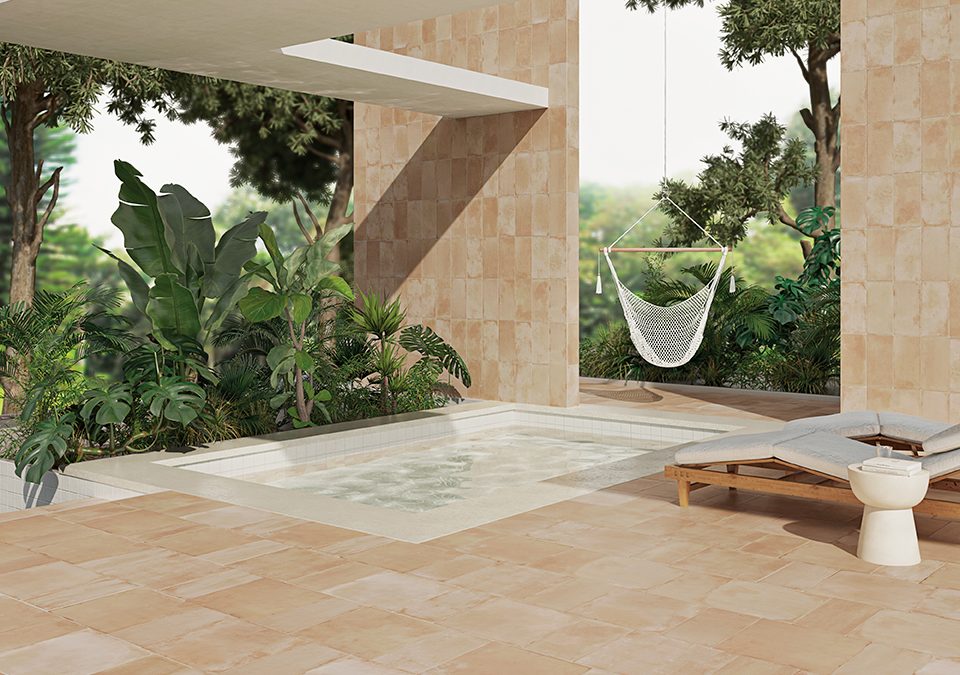
A finca lives outdoors. Running the same floor from the living room to the porch, with no change of material at the door, makes the house feel larger and calmer. For this to work you need a collection with indoor and outdoor versions in the same tone: a soft finish inside and an R11 non-slip finish or a 20 mm slab outside.
Around the pool, stone is the reference. Sinai by Coem, inspired by Golden Sinai stone, has an R11 finish and a 20 mm outdoor version; RealStone by Ragno also comes in 20 mm. We explain the technical criteria in outdoor porcelain paving in Mallorca and slip resistance in the guide to R9, R10, R11 and slip ratings.

Stairs, steps and changes of level
Fincas have stairs everywhere: up to the bedrooms, onto the porch, the steps in the garden. Using the same material on the step as on the floor gives continuity; outdoors, the step must be non-slip with a well-finished edge. We explain it step by step in porcelain stair treads.
Upkeep with Mallorca’s water
The island’s water is hard and leaves limescale on floors and in showers. With traditional materials, limescale mixes with the treatments and forces you to strip and reseal. Porcelain is cleaned with water and a neutral detergent, and limescale comes off with specific products without damaging the tile. The full routine is in how to clean porcelain tiles with hard water.
Collections for renovating a finca at Gomila Cerámica
- WOW Roots: terracotta in porcelain, indoors and out. See WOW
- WOW Abbey Stone: aged stone, Matt, R11.
- Inalco Amara: Binissalem stone in large-format MDi, 6, 10 and 12 mm. See Inalco
- Fioranese Cementine 20: encaustic tile in porcelain. See Fioranese
- Kronos Les Bois: wood in porcelain, 10 and 20 mm, outdoor line. See Kronos
- Coem Sinai and Ragno RealStone: stone in 20 mm for outdoors and the pool. See Coem · See Ragno
You can browse all our floor tiles in porcelain.
Where to see it in Palma
At the Gomila Cerámica showroom you can see the tiles at full size, compare shades in natural light and take samples to try at the finca, next to the stone or wood you plan to keep.
Gomila Cerámica · Carrer de Calçat 16, 07011 Palma
Tel. +34 971 732 343 · info@gomila-ceramica.com
Opening hours and directions
Frequently asked questions
What is the best floor for a country house in Mallorca?
It depends on the room, but porcelain is the most practical choice in most of them: it barely absorbs water, copes with damp and sun, and comes in the finishes typical of a finca (terracotta, stone, encaustic and wood). If the house keeps original floors in good condition, restore them where they shine and use porcelain in bathrooms, the kitchen and outdoors.
Can porcelain be laid in a house with stone walls and damp?
Yes, but the damp at its source has to be solved first with the project’s technician (a new slab, a damp-proof membrane or a ventilated void). After that, porcelain is one of the best-performing materials, because it absorbs ≤ 0.5 % of water and does not warp.
Is terracotta-effect porcelain suitable for outdoors?
Yes, if the collection has a non-slip finish suitable for outdoors. Roots by WOW, for example, combines a soft touch with slip resistance and can be used indoors and out.
Can I use the same floor inside and outside the finca?
Yes, by choosing a collection with indoor and outdoor versions in the same tone: a soft finish inside and an R11 non-slip finish or a 20 mm slab outside. That way the living room and the porch read as a single space.
Which floor works with underfloor heating in a finca?
Porcelain is one of the best options: it conducts heat well and does not move with temperature changes. Tiles of 10 mm or less also help avoid raising the floor level too much during the renovation.
Where can I see floors for renovating a finca in Palma?
At the Gomila Cerámica showroom, Carrer de Calçat 16, Palma, with terracotta, stone, encaustic and wood-effect porcelain collections, and samples to try on site.
Can we help with your project?
We’ll advise you with no obligation, by phone, by email or at our showroom in Palma.